Jesus prepared His disciples to spread His truth by telling them as much as they could handle, as much as the spoken word can communicate to an open mind. However, He wanted to tell them more, as He said: “I have much more to say to you, more than you can now bear” (John 16:12). Jesus then promised: “But when he, the Spirit of truth, comes, he will guide you into all truth” (verse 13, emphasis added).
Again, reading the Bible or listening to sermons isn’t enough. Complete truth only comes from a personal relationship with the Holy Spirit, for the Holy Spirit speaks to us at a level far beyond the reach of reading, listening, human vocabulary, and human reasoning. And as Jesus also said:
“When the Helper comes, whom I will send to you from the Father, namely, the Spirit of truth who comes from the Father, He will testify about Me.” (John 15:26 NASB)
In the movie A Few Good Men, there’s a climactic moment near the end of the court martial scene. In response to Tom Cruise’s character demanding, “I want the truth!” Jack Nicholson’s character shouts, “YOU CAN’T HANDLE THE TRUTH!” Without the help of the Holy Spirit, we can’t handle the truth. It’s scope and meaning won’t be fully grasped by our limited minds. Yet the Spirit of truth will open our minds to the truth:
“It is the Spirit who testifies, because the Spirit is the truth.” (1 John 5:6 NASB)
I’d read it before, though never in a coffee shop. With my medium coffee in hand—being a bit of a rebel, I refuse to say Grande, or whatever they call it—I plopped down at a table and opened my Bible to chapter 7 of Paul’s letter to the Romans. He was complaining about himself: “I do not understand my own actions. For I do not do what I want, but I do the very thing I hate. … I can will what is right, but I cannot do it. For I do not do the good I want, but the evil I do not want is what I do. … Wretched man that I am! Who will rescue me from this body of death?” (Romans 7:15, 18-19,24 NRSV). Sound familiar? It does to me.
Often in my relationships with God and others, I know what I want to do, but I cannot do it. Not enough self-control. Who will rescue me from my wretched self-out-of-control? Here’s how Paul began to answer his own question:
“The mind governed by the flesh is death, but the mind governed by the Spirit is life and peace. … You, however, are not in the realm of the flesh but are in the realm of the Spirit, if indeed the Spirit of God lives in you.” (Romans 8:6, 9)
While in grammar school, my friend Gary let me ride his mini motorcycle. Gary sat behind me while I took control (yah, right). I followed a dirt track over rises and through dips, with twists and turns and loose gravel, and I lost control, and we ended up in a pond. Really.
For me, that is a good picture of life. There are twists, turns, dips, temptations, frustrations, hardships, etc., and sometimes we lose control. Sometimes we crash. Yet we have a choice. Instead of trying to govern ourselves and steer ourselves through life, we could give the Holy Spirit control and let Him drive. We could then sit back, wrap our arms around Him, relax, and enjoy the ride. However, the Spirit won’t take control—I must surrender it to Him. Until I do, He’ll take the backseat and patiently wait for me to accept that I’m a wretched, out-of-control driver.
In my early churchgoing years, I pictured Jesus in heaven, no longer involved in the battle down here in the trenches. He’d done His tour of duty and was now sitting out the rest of the war. I never gave much thought to the Holy Spirit, as the only times it was mentioned in church was in prayers or songs that included Father, Son, and Holy Ghost.
The Holy Spirit is a facet of God who’s often more mystery than reality. For a long time, I ignored the Holy Spirit, considering it a third-rate entity, the silent partner of the Holy Trinity. However, who was I ignoring? Well, according to Paul:
“Now the Lord is the Spirit, and where the Spirit of the Lord is, there is freedom.” (2 Corinthians 3:17 NRSV)
“God sent the Spirit of his Son into our hearts.” (Galatians 4:6 NIV)
“You, however, are not in the realm of the flesh but are in the realm of the Spirit, if indeed the Spirit of God lives in you. And if anyone does not have the Spirit of Christ, they do not belong to Christ.” (Romans 8:9 NIV, emphasis added)
So, the Holy Spirit is both the Spirit of God and the Spirit of Jesus—not someone I want to ignore. But wait! What about that last sentence in Romans 8:9? Is Paul saying that anyone who ignores the Holy Spirit isn’t a true Christian? Hmm, that could explain a lot.
Ignoring that volatile question (for now), what’s the Holy Spirit do, what’s His purpose? The third member of the Holy Trinity must have some kind of holy purpose, right? As I quoted Jesus at the end of the last chapter, the Spirit will guide us into all truth, which is something we could all use more of these days. As if that’s not enough, there’s this promise from Paul:
“You were sealed in Him [Jesus] with the Holy Spirit of the promise, who is a first installment of our inheritance.” (Ephesians 1:13-14 NASB)
A first installment of our inheritance? What inheritance? Does life with the Spirit here on earth give us a preview of the life waiting for us with God in heaven? Again, that’s not something I want to ignore. With all that’s going on in this crazy world, I could use some heaven-on-earth right now.
Anyway, when Jesus returned to heaven, I suspect He knew that those He left in charge needed help, or His budding Church would wither and die. Attacks against Christianity began immediately, and enemies soon included the Roman Empire. Therefore, Jesus sent His Spirit to help protect His newborn Church. Some people believe that once Christianity survived those initial attacks and gained strength, the Spirit walked away from the battle. Yet, as Jesus said,
“I will ask the Father, and He will give you another Helper, so that He may be with you forever; the Helper is the Spirit of truth.” (John 14:16-17 NASB, emphasis added)
The Holy Spirit hasn’t abandoned the war. He’s still in the trenches, for those willing to look for Him.
The mood in the US seems to have shifted over the past 10 years or so. I suspect it started long before then but has picked up the pace more recently. The mood seems to be more hurtful, more hateful, more self-centered.
I believe the human personality consists of our good nature and our bad nature. Also, based on my own personal experience, there’s a constant battle within our soul between the good and bad natures, as they each fight for dominance. For some of us, this battle is something we’re not aware of. For others, we make a conscious effort on behalf of one side or the other.
Now then, to the theory I want to offer you and how it relates to the current mood in the US: I believe that many people, most notably Donald Trump and his closest supporters, have by their behaviors, words, actions, and characters, given us permission to let the bad side of our nature win the battle and take control of our personality. After all, that’s what they appear to have done. And it’s natural for people to follow the leaders, even in their behavior.
So today we live in a country dominated by a bad nature, where pride, selfishness, bigotry, hatred, anger, and arrogance often prevail. But I believe this mood-shifting trend can be reversed. People can take back control of their personalities and their souls. People can wrest control from their bad nature. Unless they’d rather be forever dominated by that nature.
Some modern churches preach that Jesus came to condemn those who don’t follow the rules, God’s and their rules. Now, Jesus indeed came to condemn, but not us rule-breakers. As John said,
“The reason the Son of God appeared was to destroy the devil’s work.” (1 John 3:8)
Satan has long held potent influence over humanity. He’s the designer of false versions of Christianity, the author of all lies, the patron of the graffiti hiding God’s truth. Jesus came to condemn Satan, destroy his work, and set us free from Satan’s influence. Isaiah foresaw this when he stated that Jesus would come … “to open the eyes that are blind, to bring out the prisoners from the dungeon, from the prison those who sit in darkness” (Isaiah 42:7 NRSV).
Imagine all humanity held captive in a dark prison, where Satan is the warden. We’re blinded by Satan’s lightless influence. Most people don’t know that they’re prisoners, because they don’t realize that there’s another world out there. All most of us know is this chaotic prison-world we live in, when all along God offers another option.
Now, Jesus didn’t come to condemn us because of our captivity. Rather, He came to open our eyes and free us from our captivity. As Jesus said of Himself:
“The Spirit of the Lord is upon me, because he has anointed me to bring good news to the poor. He has sent me to proclaim release to the captives and recovery of sight to the blind, to let the oppressed go free,” (Luke 4:18 NRSV)
“For God did not send the Son into the world to judge the world, but so that the world might be saved through Him.” (John 3:17 NASB)
Jesus came to testify to the truth, and it’s His truth that opens our eyes and sets us free. “Then you will know the truth, and the truth will set you free” (John 8:32).
The Jesus some of us imagine is the Hollywood Jesus: stoic, mild mannered, soft-spoken, somewhat dull and emotionless. Yet as the stories in the Bible make clear, Jesus was no otherworldly droid, immune to human emotions and pain, shuffling about dispensing miracles.
There’s a story about a man suffering from leprosy: “While Jesus was in one of the towns, a man came along who was covered with leprosy. When he saw Jesus, he fell with his face to the ground and begged him, ‘Lord, if you are willing, you can make me clean’” (Luke 5:12). Those stricken with leprosy were outcasts. People would have avoided this man. It may have been years since someone had touched him, since a hand had rested on his shoulder in a moment of comfort. “Lord, if you are willing, you can make me clean,” he said to Jesus. He didn’t doubt Jesus’ ability, only His willingness to heal him. It had been that long since this man felt kindness and compassion from another person.
We know from other stories that Jesus could have instantly healed the man with a simple command, like “be healed.” However, Jesus did something different. He did something radical. Jesus first gave the man what he needed most.
Picture the man on his knees with his face to the ground, perhaps afraid to look up, perhaps afraid he’d see Jesus turn His back on him and walk away. Now picture Jesus kneeling down in front of the man, and then … “Jesus reached out his hand and touched the man” (verse 13). I like to picture Jesus gently squeezing the man’s shoulder, followed by the man tentatively lifting his head and looking up. Seeing the compassion in Jesus’ face and feeling it in the hand on his shoulder, tears well up in the man’s eyes, run down his leprosy-scarred cheeks and into his beard.
The point is, for the first time in perhaps years, another person touched this lonely, outcast of a human being. Jesus gave the man what he needed most—love and compassion. In the midst of the emotion swelling within the man, Jesus then said, “I am willing. Be clean,” and the man was immediately healed of leprosy.
I never understood the sadness until my own children were grown and out on their own. But giving me a preview of coming emotions, my mom showed me how sad she would become every time I left home after a weekend visit. I thought she was being overly emotional. I now share her feelings whenever my sons leave after a visit home.
My wife and I miss those days when our sons lived at home; we miss the closeness, and being a part of each other’s lives. My purposes in my relationships with my sons have evolved as they’ve grown from babies into men. However, one thing that never changes is my overwhelming desire to be with them and to show my love for them.
God is patient, kind, compassionate, humble, unbiased, all-forgiving, and protective—such is God’s character. God’s primary purpose, the one that His character and other purposes point to, is to live with us and express His unconditional love for us. God’s purpose is to have His children return home. As Jesus said, “and we will come to them and make our home with them.” And God makes a way for us to return, to the way it was in the beginning, before Adam and Eve were kicked out of the Garden of Eden. As Andrew Murray said:
“When God established the plan of redemption, His objective was to restore man to the place from which he had fallen.” 1
To restore us to the place from which humanity had fallen, to bring His children back home—this is what salvation, God’s ultimate purpose, is all about.
“My Father’s will is that everyone who looks to the Son and believes in him shall have eternal life, and I will raise them up at the last day.” (John 6:40)
“For God has destined us not for wrath but for obtaining salvation through our Lord Jesus Christ.” (1 Thessalonians 5:9 NRSV)
Like Neo in the movie The Matrix, was I living in a world of deception? Neo was an unwitting prisoner in a computer-generated, virtual reality world—the Matrix. While Neo may have suspected something was wrong with his reality, he didn’t know there was another world out there, the real world, beyond the virtual world of his experience. Then Morpheus, another Matrix character, called Neo to wake up to the truth.
About twenty years ago, I first suspected I was living in a human-generated version of Christianity, where though it was put forth as true to what Jesus lived and taught, it wasn’t. I began to sense another Christianity out there, a real Christianity, beyond the Christianity of my experience. And it felt like Morpheus was calling me to wake up to the truth, a truth hidden beneath the graffiti of church history and human nature.
I struggled through those years, trying to understand what I was feeling and why. At first, I didn’t know what to do about my feelings, or how to respond to that imagined Morpheus voice. Then, realizing that “Christianity” and “Christian” are manmade terms subject to human definition and manipulation, I felt a growing desire to know how Jesus would define Christianity. What would Jesus say it means to be a Christian? So, I listened to the voice.
Eventually, a new image seeped into my mind, an image that helped solidify my resolve to search for the truth of Christianity. Picture a Bible resting on a table. The Bible—the collection of historical documents that defines Jesus’ version of Christianity—was compiled a few centuries after Jesus showed us His Christianity. Then, as the centuries ticked by, men added other books.
Where Jesus’ Christianity and what it means to be Christian is defined by God’s word as recorded in the Bible, manmade versions of Christianity are often defined and governed by those manmade rulebooks. Now, looking at that pile of books, where’s Jesus’ Christianity?
Stepping back to take in the bigger picture painted by the Bible, a new question snuck in. Why? Why are we the way we are? Why is there so much evil in the world? Why is life sometimes so difficult? Why is peace with each other, and even with God, sometimes so unattainable? And why is it so hard to believe? Without falling too deeply into philosophical notions, I guess I just wanted to know what life’s all about—the elusive meaning of life.
So much of life felt either meaningless or perilous. I wanted something solid and unchanging to hold onto, a safe place in the midst of this conspiracy-theory-dominated, truth-starved, war-rattled, chaotic world. I was craving meaning and a purpose I could believe in without fear and doubts, and I wasn’t finding that in the church I was attending.
Then it happened, a situation at church. I mean, this was a big deal. It wounded me and left me confused. That’s not true Christianity, is it? I kept asking myself. That can’t be what Jesus has in mind. The episode added to my sense of a false Christianity, a Christianity matrix that had been holding me, and those sitting in the pews next to me, captive.
I have friends who found freedom from similar situations by quitting Christianity. I wasn’t interested in going that far. Instead, I quit that church. I visited other churches around town, yet nothing felt right, and I didn’t know why. The whole experience was disorienting and depressing. I eventually decided to go it alone. However, as I later learned, I was never truly alone.
Soon after becoming a church refugee, I began spending all my spare time searching for the truth about the way of life that Jesus lived and taught, what I call Jesus’ Christianity. I suspected I’d find it somewhere under the false Christianity that held me captive. Something told me it was there, like Morpheus sending me that cryptic message, “Wake up CJ. Manmade Christianity has you.”
Entering the campus of Trinity College in Dublin, Ireland, my wife and I followed the herd of other tourists through Library Square when I looked up to see a large sign saying, “Falsehood flies, and truth comes limping after it,” by Jonathan Swift. Yes, it seems that in our society, falsehoods often prevail far more than truth. What matters most to some people is who said something, rather than the trustworthiness of what they said. For many people, truth is whatever they decide it to be. But remembering that Jonathan Swift quote has fueled my desire to give truth—that is, Jesus’ truth as defined in the Bible—a shoulder to lean on, especially when many people are kicking it in the shins.
As I stepped off on my own journey many years ago, there was a new question loitering in my mind. Jesus had said, “Then you will know the truth, and the truth will set you free” (John 8:32). But, free from what? I suspected there was something more than freedom from wounds and captivity to a manmade Christianity. I suspected there was something else holding me prisoner that I wasn’t aware of … like the matrix.
So, now it’s decision time. Will you stop here and remain captive to a distorted, manmade image of Christianity, a Christianity that may be blinding you to the truth? Or, will you follow me at least a little farther on this journey to uncover the truth? For Matrix fans, this is the blue pill or red pill moment. And like Morpheus said, all I’m offering you is the truth. Nothing more.
For many who read the Bible, they read it through figurative church-made glasses. These glasses have a special filter that consists of the Bible interpretations they’ve heard in church. As they read the Bible, the words they read go through this filter. In some cases, the words are modified by the filter so that what reaches the mind conveniently matches up with what they’ve heard in church.
Yet if they notice a conflict between what they’re reading and what they’ve heard, they may attribute the conflict to their apparent inability to understand the “complex” messages in the Bible, messages only seminary-trained pastors can understand, or so they may have been told.
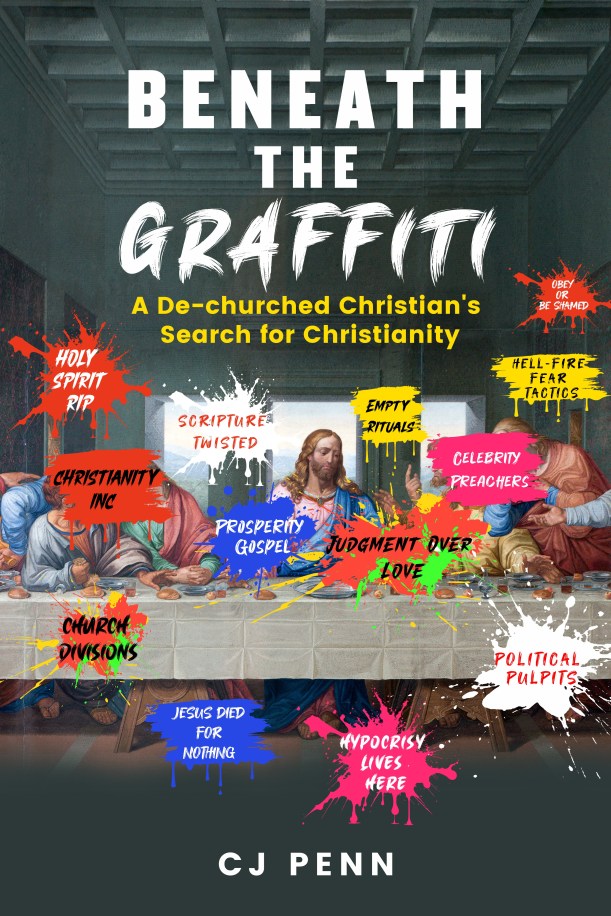
Nagged by the conflicts I’d noticed while reading the Bible—conflicts between what I had heard in church and what I was reading—I gradually removed those church-made glasses and, for the first time, read the Bible with clear eyes. That’s how I came to find true Christianity, the Christianity that Jesus lived and taught. You can read about what I found in my book, Beneath the Graffiti: A De-churched Christian’s Search for Christianity.
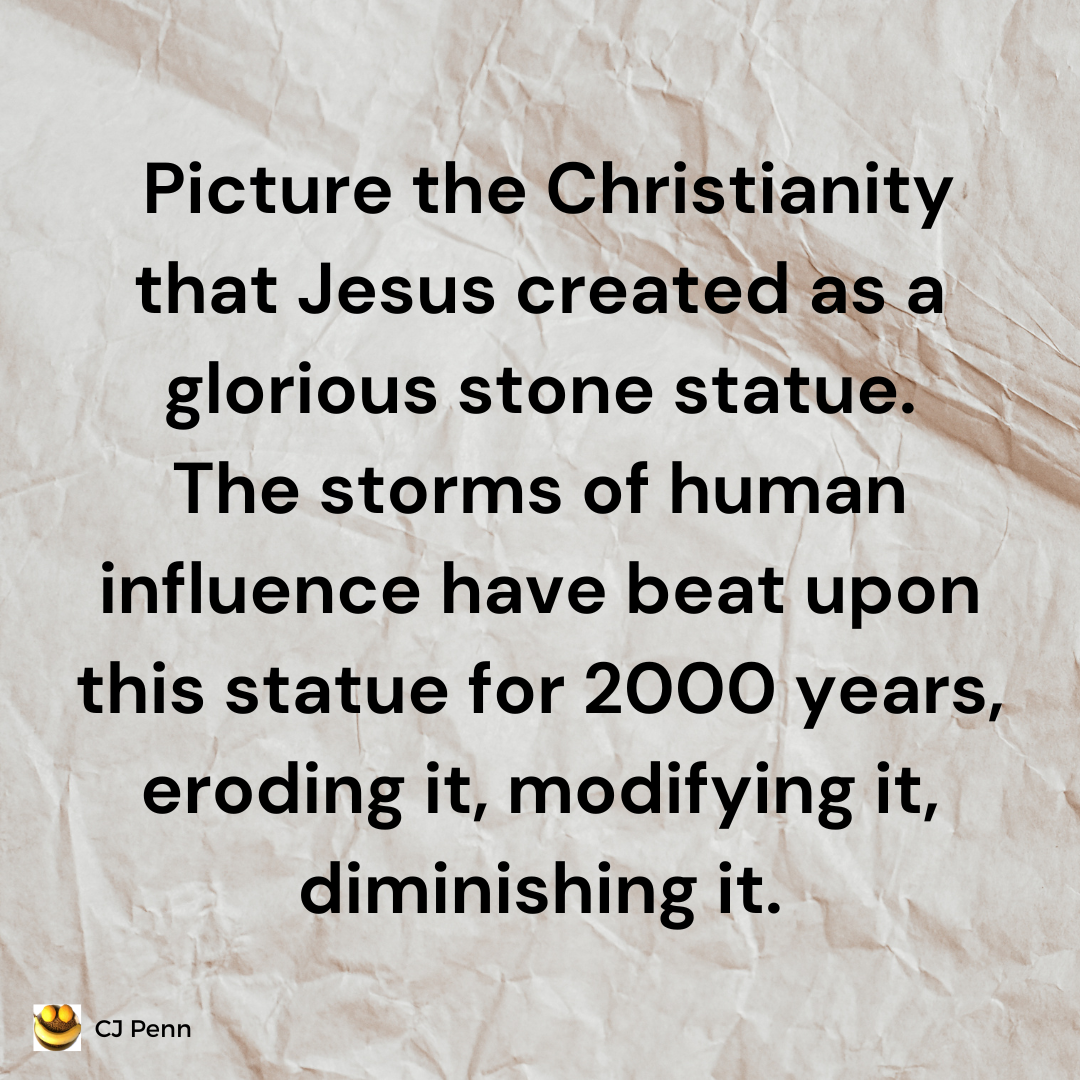
Modern Christianity suffers from 2000 years of human tinkering, manipulation, and customization. For evidence, consider the hundreds of different denominations, each with their own customized rules, doctrines, beliefs, and traditions. But how far have some of those variants drifted from what existed 2000 years ago? And what did exist 2000 years ago?
The years haven’t been kind to Christianity. The way of life that Jesus lived and taught has been scared by the influences of man. Sometimes, what we see on the surface shows little resemblance to what Jesus originated.
That’s what can happen after 2000 years—2000 years of human tinkering, manipulation, and customization. For evidence, consider the hundreds of different denominations, each with their own customized rules, doctrines, beliefs, and traditions. However, as different as they are from one another, they all call what they preach the same thing … Christianity.
But is it really Christianity, or more specifically, the Christianity that Jesus lived and taught? How far have some of those variants drifted from what existed 2000 years ago? And what did exist 2000 years ago?
Is the Christianity you’ve experienced authentic Christianity, or has it been influenced more by man that God? If that question stirs a feeling in your soul, please consider my book, Beneath the Graffiti: A De-churched Christian’s Search for Christianity. The book is a record of what I found when I peered beneath the 2000-year accumulation of manmade clutter.
The years haven’t been kind to Christianity. The way of life that Jesus lived and taught has been scared by the influences of man. Sometimes, what we see on the surface shows little resemblance to what Jesus promoted.
That’s what can happen after 2000 years—2000 years of human influence, of tinkering, manipulation, and customization. For evidence, consider the hundreds of different denominations, each with their own customized rules, doctrines, beliefs, and traditions. However, as different as they are from one another, they all call what they preach the same thing … Christianity.
But is it really Christianity, or more specifically, the Christianity that Jesus lived and taught? How far have some of those variants drifted from what existed 2000 years ago? And what did exist 2000 years ago?
That last question is the one that lingered most in my mind as I finally gave up on church, feeling that the church I’d long been a member of had drifted far off from what Jesus initiated. That question gave me a gentle shove down a path that led me on a journey in search of Christianity, original Christianity, the Christianity that Jesus lived and taught.
Is the Christianity you’ve experienced authentic Christianity, or has it been influenced more by man that God? If that question stirs a feeling in your soul, please consider my book, Beneath the Graffiti: A De-churched Christian’s Search for Christianity. The book is a record of what I found when I peered beneath the 2000-year accumulation of manmade clutter. What I found was Jesus’ Christianity hidden beneath. But be advised, for within the pages of this book you may discover more than the truth of Christianity.
Today Christians celebrate Jesus’ resurrection. May this day also signal the resurrection of His Christianity, the authentic Christianity that doesn’t suffer from 2000 years of human manipulation.
Get “Beneath the Graffiti: A De-churched Christian’s Search for Christianity” for FREE this Easter Sunday (last day of FREE promotion).
In honor of this Easter, get “Beneath the Graffiti: A De-churched Christian’s Search for Christianity” for FREE (ebook), until Easter Sunday, April 20th.
In honor of this Easter, get “Beneath the Graffiti: A De-churched Christian’s Search for Christianity” for FREE(ebook), until Easter Sunday, April 20th.