After Jesus was crucified and came back to life, his disciples had a hard time believing what they were seeing. They thought he was a ghost, still dead. They saw with their eyes, yet still did not understand. Don’t be surprised if you have difficulty understanding what you read in the bible, for even eyewitnesses had trouble.
Yet, as Jesus did for His disciples, He can do for us…“Then he opened their minds so they could understand the Scriptures.” (Luke 24:45) Understanding does not come from our own intellect, cleverness, or imaginations. Understanding comes from only one source, the Holy Spirit. “We have not received the spirit of the world but the Spirit who is from God, that we may understand what God has freely given us.” (1 Corinthians 2:12)
If you are willing, the Holy Spirit can open your mind and show you the truth. As Jesus said, “I have much more to say to you, more than you can now bear. But when he, the Spirit of truth, comes, he will guide you into all truth.” (John 16:12-13)
Jesus frequently called himself the “Son of man.” I was reminded of this while listening to a Third Day song on the way to work yesterday. And I began to wonder why He chose that title above others.
Why did Jesus seem to feel it was important to stress His humanity? Yes, Jesus is fully God, but He was also fully human. And it seems like He almost took pride in His humanity. Being one of us was important to Jesus. But why? I’ve been thinking about this since yesterday, all the time with the sense that the answer to my question was right at the edge of my mind, just barely out of reach of my consciousness.
Well, this morning I’ve been able to quiet my mind and pray, asking Jesus to give me the answer. Though I think the complete answer is still not clear to me, I do believe I see Jesus’ main reason for stressing His humanity. It’s love. Jesus loves us humans so much that He also loved being one of us.
That’s another thing that definitely sets Jesus apart from me – though He seemed to cherish His humanity, I am often pained by my humanity.
But what do you think about Jesus calling Himself “Son of man?”
Look, I’m not a trained writer. I don’t often know what I’m doing. But maybe that’s good, because the less I know, the more I rely on God.
It’s often hard for me to believe I’m writing a book. I mean, this thing is almost done, and it actually has a decent structure and is readable. For someone who never learned grammar in high school, it’s weird for me to look at this book and realize it came from my own hands.
But it’s not totally mine. This book is actually the product of prayer. I look to God in prayer, and the words for the book come into my mind. Are the words really from God or from me? I don’t know. I just know I couldn’t have done this without His help. He’s always there for me – just a thought away.
Why do some Christians distort the truth of Jesus? There are two reasons. First is ego – to gain honor for themselves. As Jesus said, “He who speaks on his own does so to gain honor for himself, but he who works for the honor of the one who sent him is a man of truth; there is nothing false about him.” (John 7:18)
Ever since Jesus preached His gospel while walking the roads of ancient Israel, people have felt the need to put their own mark on the truths He had proclaimed. Perhaps they felt their own personal revisions would improve His message. Or, maybe they were unable to accept His message as-is, and they decided to reshape it into something they could agree with.
“Everyone looks out for his own interests, not those of Jesus Christ.” (Philippians 2:21) Everyone suffers from the temptation of believing that they know more or know better than God does. This disease of pride moves some people to re-make God and His message into their image.
The second reason the truth gets distorted is that well-meaning everyday Christians portray false ideas about the truth of Christianity just by how we live. We are imperfect human beings, tasked with conveying the perfect message of Jesus Christ. Our imperfections are bound to smudge the message now and then. Our human hands too easily mar the heavenly masterpiece of Jesus.
Simon says take 5 giant steps away from the work. Pull my head out of the details and look at it as if it’s not my own. This is how I’ve started approaching the editing of the past couple revisions of the book I’m writing. I read it as if it’s not my book. I read it as if I’m one of my few close friends who I have asked to review the current draft.
So, when I see something that seems unclear or awkward or just not right, I don’t have the burden of having to find a fix. All I do is flag it as needing work. I attach sticky-notes that generally state what’s wrong with the sentence, paragraph, or entire section. Then I move on. It makes this first part of the editing process easy – just point out problem areas.
But of course, as the writer of the book I still have to eventually go back and fix all the problems I had flagged. But I’ve noticed that I catch a lot more weaknesses with this two-step editing process.
And maybe by first pretending I’m not the writer, rather just a reviewer, I’m dodging my ego; my ego that usually has problems recognizing my own errors. It sure can be hard to do good writing when my self-centered human nature gets in the way.
They made me feel like they were constantly judging my behavior and actions, always looking for some weakness to shine their spotlight on. They projected an air of superiority. They rarely hung out with anyone who was not a member of their exclusive organization. Yet they always seemed to be pressuring me to leave my life behind and join their perfect club.
But they themselves weren’t perfect. In many ways, they weren’t much different than me. This hypocrisy and the judgment and the arrogance – these are the things that turned me away. Join their club? Forget it!
For much of my life, this was my response to Christians. But eventually I started learning the truth about Christianity, and how Jesus led by His example. Jesus hung out with sinners, like me. Jesus didn’t come to judge us. Jesus loved unconditionally. And He didn’t form some exclusive club. The more I learned about the truth of Jesus, the more I realized that the ugliness I had seen in some Christians came from human nature, not Jesus. My challenge is to keep my own ugly human nature from gaining the spotlight.
“This is what the Lord Almighty says: … love truth and peace.” (Zechariah 8:19)
Truth and peace – I have to admit that I sometimes find it hard to include peace with my blog posts about truth. I indeed love the truth. When I write about truth in a way that confronts some false message within Christianity, I tend to get passionate. Yet I am sometimes a bit harsh in my response to deception. I have a hard time including peace while I lash out at some religious doctrine that is contrary to the truth of Gods word. The truth is so important to me – I lose sight of the need for compassion. My prideful human nature often closes my eyes to the peaceful approach.
The peace I wish to bring doesn’t come from me – it comes from the Holy Spirit within me. So if you read a blog post of mine that includes just the right mix of truth and peace, then you will know that I stepped out of the way and let the Holy Spirit of God speak through me. And if the peace is missing from my message, I sincerely apologize to you, and God.
The most effective lessons are the ones you figure out yourself.
Almost daily, I earnestly ask God to show me how to do something, like solving a writing problem in the book I’m working on. Though I feel His presence with me, and at times, He does seem to give me the answer, He doesn’t solve all my writing challenges.
It just occurred to me that maybe God has a good reason for not showing me the solution to all my problems. Like any good parent or teacher, maybe God is telling me that for some problems, I need to figure out the solution myself.
I was twelve years old when my mom married my second stepfather. I still remember his mother telling him he was going to hell because he divorced his first wife. That was over 40 years ago and my stepfather, now in his 80’s, still carries around the guilt piled onto him by his devout Catholic mother. He is a prisoner of that guilt. He is a prisoner by holding onto falseness that he believes just might be true. Whether you call yourself Christian or not, you may be a prisoner of lies – for lies are like shackles on our hearts and minds, hindering us from truly experiencing life.
We are all prisoners of the lies we believe to be truth. The most dreadful prison is the one where you don’t realize you are a prisoner. Did you ever see the movie The Matrix? People were prisoners without knowing it. So it can be with us. We can only be free, free to make choices based on truth, when we know the truth.
As Paul warned, “See to it that no one takes you captive through hollow and deceptive philosophy, which depends on human tradition and the basic principles of this world rather than on Christ.” (Colossians 2:8)
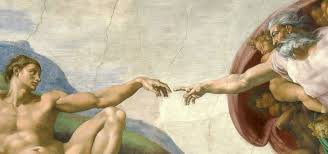
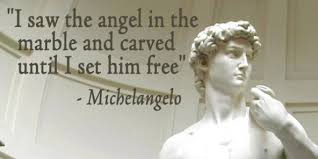
Though best known for his painting on the ceiling of the Sistine Chapel, Michelangelo’s passion was sculpting marble. And he considered that the figure he was sculpting was always present within the marble block. All he had to do was remove the surplus marble to reveal the figure within.
This is the way I’ve been approaching my writing lately. I keep chipping away at the block of words, removing the surplus junk to reveal something that will hopefully be worth looking at.
One of my favorite books on writing nonfiction is On Writing Well, by William Zinsser. Three of his key elements of good, nonfiction writing are clarity, simplicity, and brevity. This goes along with one of my favorite bible verses: “The more the words, the less the meaning, and how does that profit anyone?” (Ecclesiastes 6:11)
The first draft of the book I’m writing had grown to a flabby 205,246 words. Seven revisions later and it’s now down to 63,300 words, and still on a diet. I keep chipping away at the surplus stuff, making it simpler, clearer and way briefer. And I love the editing process. It’s fun to remove the junk that adds nothing, and discover the shorter message that is much more powerful. Though writing can be hard, editing is fun.
Yesterday coffee with the usual Wednesday morning guys. Rick brought up the stuff happening in Ferguson, Mo.: The agitators from outside the community, and even outside the state, stirring up trouble. The celebrities, like Al Sharpton, also feeding the anger. And the store owners, staying up all night guarding their shops, trying to protect their livelihood from looters. Then Rick asked a question that was hard to consider, especially since I had barely started drinking my coffee: “As Christians, what should be our response to all this?”
It would be so easy to get sucked into the anger, and lash out at one side or the other. But I really don’t think that’s what Jesus wants me to do. Look, everyone involved is just a normal, broken human being. We are all messed up, full of sin and selfishness. Things like compassion don’t seem to come naturally. It’s the ugly responses, the judgment and harsh words, that seem to naturally ooze out of us. What should be my Christian response? I choose compassion and love. For how could I judge those who are no different from me – a typical screwed up person?
Mahatma Gandhi once said, “Oh, I don’t reject Christ. I love Christ. It’s just that so many of you Christians are so unlike Christ.” It’s often Christians who push people away from Christianity. That’s why I stayed away for much of my life – what I saw didn’t appeal to me. I initially rejected Jesus because of Christians who were not a good reflection of His truth.
National surveys show Christianity declining in the United States. The published reasons are varied, but they all point to this: Christianity is crumbling because of a lack of truth. Truth is healthy and strong; untruth is sick and weak.
So I’m writing a book – Christian nonfiction – with a theme that matches most of my blog posts. I challenge false ideas about Christianity with the truth. I’ve be at this, part-time, for 6 years now. For the past 3 years I’ve been getting up at 4:00 am just so I can get in a couple of hours of writing before heading off to work. In addition to wondering if I will ever finish this book, I’m curious about something… Is 6 years (and counting) a bit extreme for a first-time book written on a part-time basis?
Yesterday I started working on revision 9 of the book I’m writing. I’m reminded of a line from a movie about Michelangelo, starring Charlton Heston and Rex Harrison; “The Agony and the Ecstasy.” In referring to the painting of the Sistine Chapel, Rex (playing the Pope), keeps pestering Michelangelo with, “When will it be finished?” And Michelangelo always has the same answer… “When it is done.” I’m feeling this way about the book I’m writing. When will it be finished? I have no idea.
My first stepfather sexually abused me when I was 7 years old. A typical situation, I suppose – he threatened harm if I told anyone. Fortunately, there were other problems with the marriage, and my mom divorced him after only a year together. But we all had scars from that experience.
My scars fed my strong desire for revenge. As I grew older and came to understand what he had done to me, I grew angrier. In my late teens, I fantasized about running into him someday. I planned each move, the first being a fully energized kick square in the source of my suffering, sending him to his knees. There were times when I even dreamed of killing him. The hate was strong and painful.
About 20 years later, I met Jesus Christ and He started teaching me about love and forgiveness. It’s taken me a long time to learn the lesson, but I finally let go of the hate. I wholeheartedly forgive my stepfather. I feel sorry for him, for he was a very troubled person. And I’m now free of my own troubles – free from the pain of hate and memories, freed by forgiveness. Thanks to the love and forgiveness of Jesus.
To me, God is my perfect parent. God, my Father, loves me unconditionally. He may not always like some of the things I do, and He may even get angry at me sometimes. But like all really good parents, there is nothing I can do that will affect the love He has for me. And like all loving parents, what He may desire most is a close, intimate relationship with His children. “Yet to all who did receive him (Jesus), to those who believed in his name, he gave the right to become children of God.” (John 1:12)
Sometimes I rant about the dealings of the Catholic Church. I truly apologize if I have offended anyone. But I have seen the effects of the shortcomings of the Catholic Church up close. I know many wounded Catholics, those who had belonged to the Catholic Church, maybe even since birth, yet left with bad experiences. My stepfather, stepbrother, and many close friends are among them.
Yet in the case of my stepfather, he didn’t leave by choice; he was kicked out because of the sin of his divorce from his first wife. It distresses me that though Jesus has forgiven my stepfather, the Catholic Church cannot.
My heart breaks for those wounded Catholics, like my stepfather, who are not able to find their way to another church. All his life my stepfather was told that the Catholic Church is the only one, true church. And when that church failed him, where can he go? He has gone nowhere, and remains lost.
If you are a “wounded” Catholic, having given up on the Catholic Church, please don’t give up on Jesus. He still loves you, and always will. God, as our ultimate and perfect Father, loves all His children, no matter what church they may go to.
“As a result the Church, to whom the transmission and interpretation of Revelation is entrusted, does not derive her certainty about all revealed truths from the holy Scriptures alone. Both Scripture and Tradition must be accepted and honoured with equal sentiments of devotion and reverence.” (Catechism 82 of the Roman Catholic Church, emphasis added) The Catholic Church considers God’s word, as recorded in the Bible, and Catholic tradition, as equally valid and important.
Jesus might say in response, “You have let go of the commands of God and are holding on to the traditions of men.” (Mark 7:8)
Moses might say, “Do not add to what I command you and do not subtract from it, but keep the commands of the LORD your God that I give you.” (Deuteronomy 4:2)
And the apostle Paul might add, “See to it that no one takes you captive through hollow and deceptive philosophy, which depends on human tradition and the basic principles of this world rather than on Christ.” (Colossians 2:8)
Catholic tradition verses the word of God – I’ll choose God.
Please, tell me your story of truth. If you’ve read any of my posts on this site, you know that the theme is all about contrasting false images of Christianity we see in our world, with the truth. Sometimes what we see is not anywhere near what the founder of Christianity, Jesus, had in mind.
I haven’t written anything on this site for a long time. The reason is that I’ve been spending my writing time working on a book. But instead of getting back to writing posts for this site, I find that I’m now more interested in hearing the experiences of others. What have you experienced in your exposure to the Christian church that may have been a false image of Christianity? Please share your story.
I know a lot of people who have been wounded by false messages coming from some churches. And I have a growing passion to help people find freedom from the pain of lies and deceptions. It occurred to me that maybe simply providing a forum to vent might be helpful. So please vent. Have you been wounded by a so-called Christian church, or so-called Christian? Then please, tell us about it, if you want to. Just comment to this post.
And if this kind of sharing becomes popular, I’ll try to find a better way to help facilitate it.
Here are some of the ways I used to feel around Christians; see if these sound familiar to your experience:
I felt like Christians were constantly judging my behavior and actions.
It seemed to me like Christians thought they were better than everyone else.
I felt like Christians disliked me and everyone else who wasn’t a Christian.
I thought Christians were flat-out weird whenever I saw them praying in public, and I’d stay far away from them, as if I didn’t want to catch whatever sickness they had.
The worst was that I always felt like Christians were trying to pressure me to convert and take on their beliefs. Just leave me alone and let me be how I want to be!!! – that’s how I felt.
Than I became a Christian. I remember my sister saying, “Oh no, are you now a Jesus Freak?” The answer was yes. Yet even though I had become crazy about Jesus, I sure didn’t want to become creepy. Ever since I decided that I really like Jesus and believe in Him, I’ve been searching for the truth of what a real “Christian” should look like. In other words, how would Jesus have Christians appear to non-Christians?
For all who call themselves “Christian,” here’s some advice from the experts (note, I like to put Jesus’ words in red, since He’s the best expert on the subject):
“Be careful, however, that the exercise of your freedom does not become a stumbling block to the weak.” (1 Corinthians 8:9)
“Therefore let us stop passing judgment on one another. Instead, make up your mind not to put any stumbling block or obstacle in your brother’s way.” (Romans 14:13)
“Do not judge, or you too will be judged.” (Matthew 7:1)
“Accept him whose faith is weak, without passing judgment on disputable matters.” (Romans 14:1)
“But you – who are you to judge your neighbor?” (James 4:12)
“Do not judge, and you will not be judged. Do not condemn, and you will not be condemned. Forgive, and you will be forgiven.” (Luke 6:37)
“And when you pray, do not be like the hypocrites, for they love to pray standing in the synagogues and on the street corners to be seen by men… But when you pray, go into your room, close the door and pray to your Father, who is unseen.”(Matthew 6:5, 6)
“Make every effort to live in peace with all men.” (Hebrews 12:14)
“Do not let any unwholesome talk come out of your mouths, but only what is helpful for building others up according to their needs, that it may benefit those who listen.” (Ephesians 4:29)
“Be merciful to those who doubt.” (Jude 1:22)
All Christians should pay attention to the advice of the experts.








 CJ Penn's Online Writing Hangout