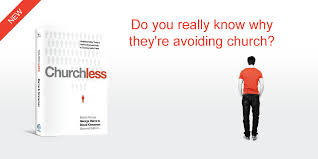
I’m a de-churched Christian. I’ve been reading the book “Churchless,” which contains lots of research data the Barna Group has collected about the various aspects of Christianity. Did you know there are about 18 million born-again Christians who no longer attend a church? The Barna study calls these people “de-churched.” It felt weird when I realized I’m one of the 18 million.
I haven’t attended church for almost five years. And what adds to the weirdness is, I can’t clearly tell you why. Oh, I could come up with surface answers easily enough. But none of them feel to me like they are the real, deep down reason I don’t go to church. And I want to know why.
It occurred to me; maybe some of these 18 million de-churched born-again Christians hang out online somewhere. So please help me if you know of any such hang-outs. Are there any Facebook groups? What other sites might the de-churched like to visit? Are there blogs for the de-churched?
My hope is that maybe by connecting with other de-churched people, I might learn why I have no desire to attend church. And if you too are a de-churched Christian, please share some of your story. It may help me, and it may help others. Thank you.
Did you know that most of the people who don’t go to a Christian church had earlier in their life attended church? This is most apparent with the young adult generation, like from 18 to 30 years old. They attended as a kid, probably because their parents dragged them there, but they followed a different path when they gained their adult freedom.
I’m reading “Churchless,” by George Barna and David Kinnaman. It’s a book based on survey results of those who don’t go to a Christian church.
I just finished reading a chapter that describes the reasons young adults no longer go to church. And then this idea slipped into my mind: instead of the traditional brick-and-mortar church, what if there were an on-line church? Maybe it could be a Facebook group, where people go to talk about Jesus. Would this be more appealing than a traditional church? Might this type of church be able to avoid the turn-offs of a traditional church?
Please let me know if there is such an on-line church. What do you think of the idea? Thanks.
I didn’t expect to start my Friday with a sad discovery. But that’s what I found as I again picked up the book I just started reading, “unChristian; What a New Generation Really Thinks About Christianity… and Why it Matters,” by David Kinnaman and Gabe Lyons. This book is based on extensive research by the Barna Group, where they conducted studies to find out what “outsiders” feel about Christians and Christianity.
I’m struggling to find the words to convey what I’m thinking, without coming across as judgmental. By the way, 87% of young adults see Christians as judgmental.
Anyway, the results of one particular survey question left me feeling sad… sad for Christians and Christian churches. The surveyors asked born-again Christians to describe what the most important priorities are for being a Christian. The top of the list was being good and not sinning, followed by discipleship, evangelism, worship, relationships with others, service and stewardship. What made me sad is that I don’t see the most important thing about being a Christian.
Yet who am I to say? I’m no expert. I’m just a flawed human like everyone else. How do I give my answer to this question about being Christian without sounding snotty and arrogant? I don’t know, so I’ll just go for it.
I believe the most important priority for being a Christian is a personal and intimate relationship with the Holy Spirit of Jesus Christ. I believe the most important good deed or form of worship is to give your life, to surrender your “self” to the Holy Spirit, to give control to the Spirit. As Paul said in his letter to those in Rome…
“Therefore, I urge you, brothers, in view of God’s mercy, to offer your bodies as living sacrifices, holy and pleasing to God – this is your spiritual act of worship.” (Romans 12:1)
The entire Bible is about a personal relationship with God, especially the New Testament. But it looks like Christian churches have not made that clear. And Christians suffer because of that. This too makes me sad.
“Every year, 2.7 million church members fall into inactivity. This translates into the realization that people are leaving the church. From our research, we have found that they are leaving as hurting and wounded victims—of some kind of abuse, disillusionment, or just plain neglect! From 1990 to 2000, the combined membership of all Protestant denominations in the USA declined by almost 5 million members (9.5 percent), while the US population increased by 24 million (11 percent).” *
Are you one of these wounded Christians? Some wounds go unnoticed, for a while anyway. For the past four years, I haven’t gone to church – I have no desire. I had stopped attending church because I was disillusioned by the messages coming from the pulpit. As I step back and look at myself as an outsider might, it now clearly looks to me like I’m a wounded Christian.
The evil that is terrorism is like a virus. It’s always infected parts of humanity. The root of this evil is pride.
Why does the Islamic extremist murder innocent people? Because they are not willing to allow others to be different from them – agree with them or die. Such is the pride and arrogance of the Islamic extremist.
We all suffer from the virus of pride, some more than others. There are those where pride consumes their existence – pride extremists.
The Islamic extremists exhibit their extreme pride violently. Others may exhibit their extreme pride with acts of greed, lording financial power over us lesser beings. Other pride extremists exercise other forms of power and control. Thankfully, not all pride extremists feed their hunger with violence.
The cure for this virus is humility. But true humility can only come from a close personal relationship with God, from letting the Holy Spirit of Jesus Christ into your inner-being. Jesus is the cure.
Being New Years Eve morning, I found myself thinking about resolutions for 2015. I’ve been big on creating long lists of resolutions in the past. This year, just one item is on my list…
As John the Baptist said, “He must become greater, I must become less.” (John 3:30)
My resolution, my hope and trust for 2015 is that the Holy Spirit of Jesus will become greater within me, and my “self” will become less. As Jesus continues to fill me with His Spirit, my selfish and self-centered self will become less of who CJ Penn is. And I’m so grateful.
I wish you all a great New Year, and hope that you too will find yourself filled with the Holy Spirit of our savior, Jesus.
I was reading some results from a Barna Group study of “churchless” in the USA. In the past decade, the number of churchless people has increased 30%. About 75% of the churchless attended church at one time… Barna calls them “de-churched.”
I have a theory: people are leaving churches because of a lack of truth. Many churches replace Jesus’ truth with their own ideas. Yet manmade theology does not have the power to affect people’s lives in a positive way. Only the truth of Jesus and the presence of His Spirit can do that. Without the truth and Holy Spirit, people give up and leave.
Ferguson Missouri. There is pain on all sides. There is suffering on all sides. There is anger scattered throughout. It mixed and boiled over last night.
It makes me sad, to see all the anger. I think it makes God sad too, looking at His children behave this way. But it’s part of who we are; broken, self-centered, childish children of God. Yes, I think God cried last night. Pain may have filled God’s heart, seeing the pain of His children.
What’s the answer? What can our society do as a group to fix what caused the pain and anger in Ferguson? I don’t know. But I know what each of us can do as individuals. Seek a close, intimate relationship with our Father God. In that relationship, we will find peace. And this peace from God can overflow us, and spill onto those around us.
The solution to the Ferguson syndrome comes from God, not man.
Yesterday coffee with the usual Wednesday morning guys. Rick brought up the stuff happening in Ferguson, Mo.: The agitators from outside the community, and even outside the state, stirring up trouble. The celebrities, like Al Sharpton, also feeding the anger. And the store owners, staying up all night guarding their shops, trying to protect their livelihood from looters. Then Rick asked a question that was hard to consider, especially since I had barely started drinking my coffee: “As Christians, what should be our response to all this?”
It would be so easy to get sucked into the anger, and lash out at one side or the other. But I really don’t think that’s what Jesus wants me to do. Look, everyone involved is just a normal, broken human being. We are all messed up, full of sin and selfishness. Things like compassion don’t seem to come naturally. It’s the ugly responses, the judgment and harsh words, that seem to naturally ooze out of us. What should be my Christian response? I choose compassion and love. For how could I judge those who are no different from me – a typical screwed up person?
The Catholic Church is the one and only “true” church, or so some believe. According to a July 10, 2007 article I stumbled across (see it here), “Pope Benedict XVI has reasserted the universal primacy of the Roman Catholic Church, approving a document released Tuesday that says Orthodox churches were defective and that other Christian denominations were not true churches.”
The Vatican document said. “The other communities cannot be called ‘churches’ in the proper sense because they do not have apostolic succession — the ability to trace their bishops back to Christ’s original apostles.” Specifically, if a church cannot trace the succession of its leadership back to the apostle Peter, then it cannot be called a true church of Jesus Christ. Since the Catholics claim Peter as their first Pope, then that makes the Catholic Church the one and only “true” church.
You see, when Jesus stated that Peter was the rock on which He would build His church (Matthew 16:18), the Catholic Church took that to mean that Peter was the starting point, the true cornerstone of the foundation of Jesus’ church. Was Jesus’ intention to have Peter as the one foundation from which He would build His united church? What else does the bible say?
At one time, Jesus sent out His 12 apostles to, “preach the kingdom of God and to heal the sick.” (Luke 9:1-9) Another time, He sent out 72 others to, “heal the sick and tell them the kingdom of God is near you.” (Luke 10:1-20) Does this sound like the act of someone who would place the responsibility for His church on the shoulders of just one man? It appears to me like Jesus intended to spread the responsibility around.
There was another time when the 12 apostles got rather ticked off when they discovered there was someone outside their inner circle who was doing their job. So they went to Jesus and blew the whistle on this guy… “‘Teacher,’ said John, ‘we saw a man driving out demons in your name and we told him to stop, because he was not one of us.’ ‘Do not stop him,’ Jesus said. ‘No one who does a miracle in my name can in the next moment say anything bad about me, for whoever is not against us is for us.’” (Mark 9:38-40) Does this sound as if Jesus is trying to establish some kind of exclusive club? It sounds to me like Jesus doesn’t care who is doing the work, as long as they are doing it “in His name.”
And what about Paul, who was not one of the original apostles? The Catholic Church appears to ignore him. So the churches he started were “defective”, I suppose. I’m sure that would come as a surprise to Paul, especially since Jesus himself gave Paul the assignment. As evidenced by the calling of Paul, Jesus was not exclusive. Why would He be? Such an approach would limit the growth of “His” church. Why send the church off in one direction, with Peter as the lead runner, when you can start off in multiple directions?
***************************************
Yet, the Catholic Church originally had worthy intentions. For a time, the Catholic Church was indeed the one true church, assuring and enabling the unity that Jesus prayed for (John 17:20-23). Their motives were noble. Jesus wanted unity, and the Catholic Church provided a way. Then, in the early 1500’s, the reformation happened and the church split into pieces; no more unity.
However, maybe having all believers belonging to the same organization is not what Jesus had in mind when He prayed for unity. Maybe he meant united in beliefs, rather than united in affiliation. Maybe it wasn’t that He wanted us all to belong to the same religious establishment, with the same human leader, but that we all look to Him and Him alone as our leader.
Jesus wasn’t praying for all believers to be united by man-made things, such as religious bureaucracies, ceremonies, traditions, and “holy” relics. Jesus was talking about being united by spiritual things, such as love for God and faith in the saving power and love of His Son Jesus Christ. Jesus asked His Father God, “…that they may be one as we are one.” (John 17:22). The unity that Jesus prayed for is modeled by His relationship with God.
Were God & Jesus unified by a common membership in some kind of organization? No, their unity was much higher than some human standard. The Catholic Church has set a human standard for unity; membership in their organization. But Jesus’ standard is a heavenly standard – a shared communion with the Holy Spirit of God. We are to be united as Jesus and God are united. How can a man-made religious establishment bring such a thing about?
I do not believe that Jesus intended for a man-made institution to bring about such spiritual unity, for I think that would be impossible. Jesus sent the Holy Spirit, His presence in each of our lives, to manifest the spiritual unity of love and faith. By our mutual connection to the Holy Spirit, we are all connected to each other. We may all be one by our common bond to the Holy Spirit. We are all branches, and we are unified by our common bond to the vine, which is Jesus Christ, by the Holy Spirit (John 15:1-17).
By the way, Jesus never even mentioned a human-made and run organization as the foundation for our unity. In fact, setting the Catholic Church as the standard for unity is a distraction from our true foundation, our true cornerstone – Jesus Christ.
And another thing: Jesus was the origin of His church, not Peter. Jesus is the vine, not Peter. Jesus is the cornerstone, not Peter. Jesus is the one true church, not the Catholics.
Yesterday I wrote about the newest Catholic advertising campaign, “Catholics Come Home” (find it here). Since writing that post, I keep wondering why the church has selected Madison Avenue as their ad agency, instead of Jesus Christ.
In pursuit of an answer, I want to look at what the Catholic Church thinks is the root problem. As mentioned in the newspaper article I referred to in yesterday’s post, one of the key people behind the ad campaign said, “There is no doubt that the glitter and glamour of pop culture has distracted people from God and his church and family.” Okay, so dwindling attendance is the fault of our culture. Interesting.
I know of a non-denominational church that is growing, even in the midst of the “glitter and glamour of pop culture.” I’ve visited them, and there is no pretense, no traditions, no catechism that is larger than the bible itself. There is only the untarnished truth of Jesus Christ. From one Sunday to the next, the pastor preaches the pure gospel of Jesus Christ. And the people keep coming, and the empty chairs seem to be fewer and fewer each week. So much for the effects of culture.
The article also described one of the TV commercials that has people watching scenes from their past with “examples of their own poor or embarrassing behavior.” This sounded odd to me, so I went to the “Catholics Come Home” web site (find it here), where I found the video (click on the “Movie” TV ad and see for yourself). I was sadly astonished at the nature of the ad; the focus is on the flaws of the individual. The church is trying to put the blame on those who have drifted away.
Another commercial, called “Testimonials,” has people apologizing for having drifted away from the church. Again, the fault is apparently with them, not the church.
So, the church is blaming society and those individuals who are no longer sitting in the pews. Blaming others, that’s easy. That must be why they are going with the TV ads. Yet, this is nothing but a distraction, though perhaps non-intentional.
As I mentioned in yesterdays post, the root cause of their attendance problem is inside the Catholic Church, not outside. The TV commercials put the focus on the outside, on those who have left the church. Yet in doing so, the church is hiding from the real problem. Why? Why not make internal changes that would address the real issues? Because doing so would be to admit fault, and egos have a difficult time admitting fault (I speak from personal experience here).
It’s beginning to look to me like the Catholic Church is more motivated by full pews, than the spiritual well-being of those sitting in the pews. Someone once said something like, “We have found the enemy, and they are us.” The Catholic Church needs to find the humility to admit their faults. Blessed are the humble.
So why am I so critical toward the Catholic Church? After all, who am I to judge? But I care. I care about those who have been deceived by the doctrine of the Catholic Church. I know too many “wounded” former Catholics, and several of these have totally lost their faith.
I know that nothing is impossible with God, but it’s still hard for me to envision real change in the Catholic Church. There’s just too much baggage and history and “rules taught by men.” So for now, my prayers are more focused on the people, rather than the organization. May God help them all.
“Peace I leave with you; my peace I give you. I do not give to you as the world gives. Do not let your hearts be troubled and do not be afraid.” (John 14:27)
The Catholic Church has joined the Methodists in their belief that you can bring people to God with Madison Avenue advertising techniques, with an ad campaign called “Catholics Come Home.” (to see my post about the Methodist ad campaign – click here). According to an LA Times article that was recently reprinted in my local newspaper: “Using a strategy straight from the secular playbook… the (church) is preparing to air several thousand prime-time TV commercials.” You can preview the commercials here: http://www.catholicscomehome.org/
The article opened with: “Catholic church leaders using TV ads in attempt to lure back lapsed followers.” The target audiences are those who call themselves “Catholic” yet do not attend church, and those who call themselves former Catholics.
According to the article, some of the reasons people are no longer attending the Catholic Church include:
Many Catholics don’t have “a sense of belonging,”
Many believe they can be “good members of their faith without attending Mass regularly,”
Many do not believe missing Mass is a sin, (Missing mass is a sin? Really?)
Others are too busy with family or work; “as analysts point out, (people) are more interested in material happiness than spiritual fulfillment.”
“About 1 in 4 former Catholics cited the church’s priest-abuse scandal as a factor.”
“People oftentimes lose sight of what is most important in their lives,” says a Sacramento Bishop.
I wonder how TV ads are going to address these issues. You typically cannot resolve circumstances like these with advertising, though maybe they can try to “guilt” people into going back to church by reminding them that missing mass is a sin.
My sincere concern is that the Catholic Church has been deluded into believing that advertising will fix the root cause of their attendance problems. How will advertising get people more interested in spiritual fulfillment rather than material happiness? How will advertising heal wounds caused by the priest-abuse scandal? How will advertising give people a clear vision of what should be most important in their lives (this sounds like a job for the pulpit, not the TV)?
***************************************
If advertising is not the fix, what is, and what is the root cause of the “lapsed followers?” I’ve watched some of the commercials, and they say nothing about what has contributed to runaway members. Based on what’s in the newspaper article, along with some of my own personal experiences, here are some guesses for why people leave the Catholic Church:
Lost trust: How can you trust a system that harbors abusive priests?
Lack of knowledge of the truth of Jesus Christ: Knowledge of the truth will help grow a hunger for spiritual fulfillment, rather than material happiness.
Lack of knowledge of the love of Jesus Christ: With a true understanding of the magnitude of the love of Jesus Christ, comes a hunger and thirst for more. This is what brings people to church, and keeps them coming back.
Lack of knowledge of what truly should be the most important thing in our lives, which is: a one-on-one, personal relationship with Jesus Christ. I wonder; does the Catholic Church promote such a relationship between each member and Jesus?
Maybe I’m simple-minded, but the solution seems straightforward to me: instead of investing in TV commercials, the Catholic Church needs to get back to it’s roots, which is the gospel of Jesus Christ. The Catholic Church seems like a branch that has broken off from the vine. As Jesus said,
“No branch can bear fruit by itself; it must remain in the vine. Neither can you bear fruit unless you remain in me. I am the vine; you are the branches.” (John 15:4-5)
I’m hesitant to be harsh, but it seems to me that the Catholic Church has replaced the reality of Jesus Christ with traditions, man-made Catechisms, man-made rules, and man-made advertising. My recommendation would be to drop the TV commercials and preach the truth of the gospel.
Instead of advertising, the Catholic Church needs to introduce people to the Holy Spirit of God. Instead of relying on Madison Avenue to spread the word, how about relying on word of mouth, carried forward by the Holy Spirit himself? It was good enough for Jesus. Remember how 3000 people joined the fledgling church in a single day (Acts 2:41)? Such is the power of the Holy Spirit.
“And this is his command: to believe in the name of his Son, Jesus Christ, and to love one another as he commanded us. Those who obey his commands live in him, and he in them. And this is how we know that he lives in us: We know it by the Spirit he gave us.” (1 John 3:23-24 NIV)
Evangelism via TV commercials, or as D.L. Moody once said, “There is no better evangelist in the world than the Holy Spirit.” I’ll put my faith in the Holy Spirit.
A final message for wounded Catholics:
Though I pray for the Catholic Church, my limited imagination is not able to truly believe that it can change. Yet I know that with God, all things are possible. Maybe one way for the church to change is for the people to change. Maybe if enough “wounded” Catholics follow their heart by leaving the Catholic Church and then finding true fulfillment and purpose in another church, maybe this will open the eyes of the Catholic Church. If you are a wounded Catholic, my prayer is for you. Please do not give up. My hope is for you, that you find another church that lives by the true gospel of Jesus Christ, the life-giving gospel; that you come to know Jesus and His Holy Spirit, and grow into an intimate relationship with them, so intimate that you are never apart. And that you come to feel more alive than ever before, by the grace and love of Jesus Christ. Amen.
The Lutherans have joined the ranks of the Episcopals, by voting in favor of actively gay clergy. This news hit the media over the weekend, and there’s a good chance you’ve seen it by now. I offer no additions to the news, just some thoughts on the implications.
First of all, homosexuality is a sin. Therefore, the Lutheran church has given approval for openly active sinners to be clergy. If you would like to see the reasoning behind this statement, please check out the following post: “Episcopal church wants a divorce.”
I have friends who will reluctantly agree that homosexuality is a sin, but they are quick to point out that it is a minor sin, with no real victims. Yes, it’s easy to come to that conclusion, but how does God look at it? What is God’s perspective on different sins?
A friend of mine once gave me the following illustration: draw a straight line one mile long, adding hash marks every 10 feet. The beginning of the scale, at zero feet, represents absolute evil; the far end of the scale, at the mile marker, represents absolute good. God is standing at the mile marker – absolutely good.
Take a mass murderer and place him somewhere on the scale, say at about the 10 foot mark. He’s not absolutely evil, since he did something good at one point in his life. Next, have an adulterer take their place on the scale, maybe say at 50 feet. Now how about someone who is very arrogant, selfish and uncompassionate; put them at about 75 feet. And finally, have someone who is actively homosexual stand at about the 100 foot hash mark; they are not nearly as bad as the other sinners on this scale.
The relative location and spacing of these different sinners is not actually important. What is important is how they look from God’s perspective. As God looks back at these sinners, almost a mile away, can He really see much of a different in how far away they are from Him? Now the length of my scale is most likely way off. Instead of one mile distance, God’s goodness probably places Him over a hundred miles from us sinners. To Him, we are all at the same level.
This is what He meant when Jesus said; being angry with your brother is as subject to judgment as murder.
“You have heard that it was said to the people long ago, ‘Do not murder, and anyone who murders will be subject to judgment.’ But I tell you that anyone who is angry with his brother will be subject to judgment.” (Matthew 5:21-22)
And if that message is not clear enough, thinking of sinning is the same as the sin…
“You have heard that it was said, ‘Do not commit adultery.’ But I tell you that anyone who looks at a woman lustfully has already committed adultery with her in his heart.” (Matthew 5:27-28)
From God’s perspective, all sinners are the same. Now do me a favor and visualize an actively arrogant and selfish Lutheran minister. Not very appealing, is he? You know where this is going… Now, visualize an openly active adulterer as a Lutheran minister. Some clergy have been kicked out of the church for less. Next, visualize the openly active mass murderer as a Lutheran minister. Time to run to another church. But finally, visualize the openly active gay person as a Lutheran minister. There is no difference. From God’s perspective, all sinners are the same.
What the Lutheran church has forgotten, and what the Episcopal church has forgotten, is that it’s God’s perspective that counts. But these churches have chosen to ignore God, in favor of the world.
… from Jesus Christ. “The Episcopal Church voted overwhelmingly Tuesday to open the door to consecrate more bishops who are openly gay.” So says the opening statement of a New York Times article that was reprinted in my local newspaper on July 15th. This vote took place at the 2009 General Convention of the Episcopal Church. This is perhaps not big news to you, but I wish to dwell on the implications.
First I would like to comment on several of the more choice statements that appear in the Times article, along with a follow-up article that was published two days later.
To begin, many convention delegates, “… note that the church has hundreds of openly gay laypeople, priests and deacons, and that its democratic decision-making structures are charged with deciding who merits ordination.” So they are saying, the majority rules, but what Jesus says doesn’t matter. I would like to think that Jesus’ vote counts for something.
Choice statement #2: “It’s an attempt to deepen relationships with the rest of the communion, because real relationships are built on authenticity.” What about being authentic with Jesus? Maybe because the Episcopal church doesn’t have a relationship with Jesus, authenticity with Him doesn’t matter.
Choice statement #3: “But some at the convention warned that the Episcopal Church could pay a price for snubbing its international partners.” What about the price for snubbing Jesus?
Choice statement #4: “‘It is time for our church to be liberated from the hypocrisy under which it has been laboring,’ Bishop Stacy Sauls of Lexington, Ky., told his fellow bishops on Tuesday.” Indeed! Like the hypocrisy of calling themselves “Christian” when they refuse to even acknowledge Jesus Christ.
Choice statement #5: In interviewing a particular convention delegate, the article states, “… he said he believes that the church can grow by emphasizing ‘inclusivity,’ the favorite buzzword of Episcopalians.” I’d like to propose a new buzzword for them: “Jesus”. They seem to have forgotten that one.
Choice statement #6: Referring to many of the attending bishops, “Above all, they are concerned that the Episcopal Church has jeopardized its place in the Anglican Communion, the international network of churches that trace their roots to the Church of England.” What about being concerned about jeopardizing their place with Jesus?
And finally: “To theological conservatives, these are signs of a church that will ultimately collapse because it has sold its soul to secular political causes.” What a sad statement, but apparently all too true.
*****************************************
Yet, what is the official documented position of the Episcopal Church? Since newspaper articles can sometimes contain errors, I went in search of an authorized statement. Resolution DO25 defines the issues that were voted on and approved. You can check it out for yourself (find it here), and you will find that there is no mention of Jesus Christ. It appears to boil down to their buzzword, “inclusivity.” That word is more important to them than Jesus’ word. To me, no mention of Jesus is proof they no longer care about Him.
*****************************************
I suppose you could say there is nothing overtly wrong with the Episcopal church failing to make any mention of Jesus. I don’t think I buy that, but now I want to look at the issue that was voted upon, the ordination of gay bishops.
It’s widely known that Jesus did not directly say that homosexuality is a sin. But look at His definition of marriage:
“But at the beginning of creation God ‘made them male and female. For this reason a man will leave his father and mother and be united to his wife, and the two will become one flesh.’ So they are no longer two, but one. Therefore what God has joined together, let man not separate.” (Mark 10:6-9)
Marriage, being exclusively between a man and a woman, at least hints at Jesus’ view of homosexuality.
However, the rest of the bible is clear. For example, Paul succinctly states that, like many other common lifestyles, homosexuality is indeed a sin:
“Do not be deceived: Neither the sexually immoral nor idolaters nor adulterers nor male prostitutes nor homosexual offenders nor thieves nor the greedy nor drunkards nor slanderers nor swindlers will inherit the kingdom of God. And that is what some of you were. But you were washed, you were sanctified, you were justified in the name of the Lord Jesus Christ and by the Spirit of our God.” (1 Corinthians 6:9-11)
Therefore, in God’s eyes a homosexual is no different from me. I happen to be heterosexual, but I am also a sinner. In God’s eyes, the only difference between a gay person and me is the nature of our sins. Some of our sins are different, some we may share.
But the real difference between a gay Episcopal bishop and me, is our personal response to our individual sins. I repent, they don’t. I acknowledge which behaviors of mine are sinful, and I constantly ask God for help in changing my ways. The gay Episcopal bishops see nothing wrong with their behavior, as evidenced by the fact that they deny homosexuality is a sin.
Looking back at the verses from 1 Corinthians above, in the behaviors of those who will not “inherit the kingdom of God;” I’m in there, along with the homosexual bishop. But, because I continually strive to repent and change my ways, “…you were washed, you were sanctified, you were justified in the name of the Lord Jesus Christ and by the Spirit of our God.” The singularly principal theme of the New Testament is this: have faith and repent of your sins, and you will be forgiven. By looking at the Episcopal church and their recent decisions, it’s safe to say there is no repentance. And based on the apparent absence of Jesus Christ in the Episcopal church, I would also say there is no faith.
So what’s my bottom line here? The Episcopal church has “sold their soul to secular political causes.” They have divorced themselves from their founder Jesus Christ, so they can marry anyone they choose. They are no more “Christian” than a Buddhist or Muslim.
“Shrinking mainline Protestant denominations are turning to marketing to help stem decades of membership losses and stay afloat.” So begins an Associated Press article I recently read in my local newspaper. It seems churches, such as the United Methodist Church, believe large amounts of advertising dollars will help fill the pews again. The Methodists are spending $20 million on their ad campaign.
I can’t help but wonder, what would Jesus do if he were in charge of filling the pews? Would he throw money at the problem of dwindling attendance, or something else?
Jesus and his apostles were faced with a similar challenge around 2000 years ago; how to increase attendance. And yet in a single day, the church in Jerusalem added 3000 new members (Acts 2:41). Christianity spread throughout the Mediterranean in a phenomenally rapid manner, and without the help of television, the internet, or pesky telemarketers. How did they do it? What was their “marketing” secret?
The answers to these questions illustrate the differences between them and today’s mainline churches. The first church leaders devoted themselves to the truth. They were passionate about spreading the truth of the gospel. Their message was not always popular, and many lost their lives because of it, but that didn’t stop them from sticking to the truth.
Today’s mainline churches take a different approach. Many of them preach whatever they think would be a popular message, the politically correct message, with little regard for the truth. They have lost touch with Jesus. That is why they continue to shrink; they are no longer attached to the true vine. When a branch is cut from the vine, it shrivels up and dies. That is what is happening to many mainline churches today, and no amount of advertising will help. What they need to do is become re-attached to Jesus.
“I am the vine; you are the branches. If you remain in me and I in you, you will bear much fruit; apart from me you can do nothing. If you do not remain in me, you are like a branch that is thrown away and withers; such branches are picked up, thrown into the fire and burned.” (John 15:5-6)
I dare say that the $20 million from the Methodist Church would be better spent feeding the poor, rather than feeding Madison Avenue ad agencies.
Have you seen the video on YouTube? If you haven’t seen Susan Boyles bring shock and awe to the judges and audience of the TV show “Britain’s Got Talent”, then follow this link and I hope you find joy in it… (YouTube video).
I watched for the first time last night, and tears came to my eyes. Not rolling tears, but the kind you can just feel welling up and making your nose sniffle. Then this morning, as I read the article in the newspaper with a bit more information about Susan Boyles the person – the tears flowed this morning. For me, Susan Boyles is a true hero, or rather heroin, just when I need one.
This is not the kind of thing I normally write about, but I am so move by Susan and her story, that I just had to express some of my feelings. The world is a mess, and lately it just seems to be getting messier. Military conflicts, pirates, lost jobs, the grim economy and vaporized savings; it all takes its toll. But then comes someone like Susan Boyles, who for me is a bright ray of sunshine. I think we all need heroes. Thank you Susan for just being you – the best kind of hero there is.
I think that concept of simple heroism kind of caught the judges and audience off guard. We are so used to our hero’s being glamorous, but then someone like Susan Boyles reminds us that it’s the unpretentious hero’s who are the most endearing and captivating.
Christians are driving people away from God, according to a recent survey. If you’ve visited my blog before, you might have picked up on the fact that I definitely believe that Christianity is its own worst enemy. Yesterday I discovered that other people feel the same way.
In the editorial section of yesterdays newspaper was an article by syndicated columnist Leonard Pitts. The title, “Religion is driving people away from God” immediately caught my attention. The article sites the results of the recent American Religious Identification Survey (ARIS), conducted by researchers at Trinity College (find it here).
The survey results show that Christianity, along with other religions, is on the decline in the United States. Mr. Pitts mentions that he believes the cause is simply that “religion has become an ugly thing.” I agree.
In the highlight section of the ARIS survey, the following claim is made: “The challenge to Christianity in the U.S. does not come from other religions but rather from a rejection of all forms of organized religion.” Organized religion is pushing people away from Christianity and away from God. Is that pathetic or what?
This “organized religion” is not the kind of Christianity that Jesus created. Jesus had something else in mind when he launched the apostles off on the mission to make disciples of all nations. But the bright side of this story is that there remain glimmers of hope and truth within Christianity. There are some churches that remain true to His word. And my hope and purpose for this blog site is that here too will be found the truth of Jesus Christ.
“City council drops moment of silence” – so stated the headline of the lead article in today’s local newspaper. The article went on to say, “The City Council has dropped its ritual moment of silence at the start of meetings, and some members questioned whether the Pledge of Allegiance should go next.”
As I read on, I wanted to know why. Why get rid of the moment of silence? The answer came two paragraphs later…
“The change came at the request of one of the council’s newest members, who said the practice could be seen as a form of prayer and might offend those who don’t want to participate.”
It didn’t really answer my question, yet there were clues. But it got me thinking about a more general issue which goes far beyond whether or not to observe moments of silence in small-town council meetings. There is a movement underway endeavoring to wipe out anything religious. Our country which was founded because people were looking for freedom of religion, is now a country where there is a strong push for freedom from religion.
Again I ask why, yet regrettably I think I already know the answer, and the answer actually goes far beyond the anti-religious movement. Why are people anti-moments-of-silence? Why are some anti-anything-religious? Why are others anti-(name any group of people, political party, belief, etc.)?
It’s all about selfishness and arrogance.
The new city council member either wants to exert new-found power because of his arrogance, or he just cannot stand the idea of other people believing differently than he does; again, because of his arrogance.
Arrogance is why the minority side of any issue thinks they should have it their way. People in our society are just unwilling to loose. They are unwilling to accept something they don’t happen to personally support. It’s the “me generation” gone wild. There is an epidemic of arrogance, selfishness and even bigotry, on the rise in our generation.
The anti-religion movement is rooted in selfishness as well. An atheist wants to make a name for himself, and becomes intoxicated on the power of his influence. Or maybe because of their bigotry (which is another form of self-centeredness and arrogance), they despise those who are different from themselves. Had you ever considered attacks on religion by atheists as an act of bigotry? Think about it.
And the “religious” are not immune. No one is immune from the diseases of the ego. All of the world’s conflicts, whether among nations or married couples or just two co-workers, are rooted in self-centeredness and arrogance. Get over it people!
We need to all grow up and stop acting like spoiled brats. We cannot always get our way, and we just need to accept that. And we need to start thinking more about others, and less about our selves.
What our society needs more than anything is a good old-fashioned dose of humility. And this actually gets me back to the bible, where humility is held in high esteem. For as Jesus said,
“Blessed are the meek, for they will inherit the earth.” (Matthew 5:5)
Do you believe you aren’t good enough for God to care? Well, God does care, just like a loving parent. But like a parent, God knows when to hold back and not interfere in your life.
A wise parent, when observing their adult child struggling with a problem, may themselves struggle with the desire to jump in and help find a solution. But the wise parent will hold back and wait. They wait for their child to either find their own solution, or admit they cannot, and finally ask for help.
God is the wisest of parents. He will not interfere; He will not help you until and unless you ask. The real power behind asking is this: in asking you exhibit a humility that admits you cannot do it alone, and you exhibit a faith in God that shows you believe in Him. Of course, asking is power-less unless you ask with humility and faith. I once wrote a post on asking God for help. I really hope you check it out (see it here).
And no matter what you may have done in the past, no matter how “good” or “bad” you think you may be, God loves you and He wants to help you. Yet it’s critical that you realize what’s important is faith, not how good or bad you are.
“A person is not justified by observing the law, but by faith in Jesus Christ. So we, too, have put our faith in Christ Jesus that we may be justified by faith in Christ and not by observing the law, because by observing the law no one will be justified.” (Galatians 2:15-16)
“The only thing that counts is faith expressing itself through love.” (Galatians 5:6)
Help from God does not come from obedience to His laws, but rather by faith in His son. We do not become “right” by doing right; this is because none can do right always, there are none without sin. Therefore, our only hope is faith.
Being right in God’s eyes; being “good” in God’s eyes comes from faith in Jesus Christ, not obedience. Do you feel you are not good enough? Do you feel you are not worthy of God’s love? Being “good” and being “worthy” are not what’s required. The only thing that counts is faith.
During this holiday season, if you are down and in despair, please look to God and put your trust and faith in Him. And with humility and faith, ask Him to help you out of your despair.
Do you find yourself out of work this holiday season? Are you in despair and feeling like you don’t know where to turn for help? Maybe the idea of seeking help from God has crossed your mind, but you’ve ruled it out for some reason. Maybe you feel like your past is too dark for God to be willing to help you. Maybe you feel like you’re just not good enough. Or maybe you feel like you just don’t know God well enough for Him to be willing to help you. Do you feel like you need to be “special” before God will answer your prayers?
I may have news for you: God is more gracious and loving than that. Today I wish to give you a Christmas card of sorts. Today I give you God’s words, dedicated to you.
Please read these words as your prayer to God…
“Remember not the sins of my youth and my rebellious ways; according to your love remember me, for you are good, O Lord.” (Psalm 25:7)
“Turn to me and be gracious to me, for I am lonely and afflicted. The troubles of my heart have multiplied; free me from my anguish. Look upon my affliction and my distress and take away all my sins.” (Psalm 25:16-18)
“Good and upright is the Lord; therefore he instructs sinners in his ways. He guides the humble in what is right and teaches them his way.” (Psalm 25:8-9)
“Do not let me be put to shame, nor let my enemies triumph over me. No one whose hope is in you will ever be put to shame,” (Psalm 25:2-3)
And please read these words as Jesus Christ responding directly to you…
“It is not the healthy who need a doctor, but the sick. But go and learn what this means: ‘I desire mercy, not sacrifice.’ For I have not come to call the righteous, but sinners.” (Matthew 9:12)
“Come to me, all you who are weary and burdened, and I will give you rest.” (Matthew 11:28)
“Do not let your hearts be troubled. Trust in God; trust also in me.” (John 14:1)
“For God so loved the world that he gave his one and only Son, that whoever believes in him shall not perish but have eternal life.” (John 3:16)
“For I did not come to judge the world, but to save it.” (John 12:47)
“Peace I leave with you; my peace I give you. I do not give to you as the world gives. Do not let your hearts be troubled and do not be afraid.” (John 14:27)
“My command is this: Love each other as I have loved you.” (John 15:12)
“Go now and leave your life of sin.” (John 8:11)
My Christmas wish for everyone who reads this post is this: may you feel God’s presence and feel His love, more than ever before. And may you feel freedom from the things that cause you to worry; may you feel the un-wavering peace that can only come from Jesus Christ.






 CJ Penn's Online Writing Hangout