The Jesus some of us imagine is the Hollywood Jesus: stoic, mild mannered, soft-spoken, somewhat dull and emotionless. Yet as the stories in the Bible make clear, Jesus was no otherworldly droid, immune to human emotions and pain, shuffling about dispensing miracles.
There’s a story about a man suffering from leprosy: “While Jesus was in one of the towns, a man came along who was covered with leprosy. When he saw Jesus, he fell with his face to the ground and begged him, ‘Lord, if you are willing, you can make me clean’” (Luke 5:12). Those stricken with leprosy were outcasts. People would have avoided this man. It may have been years since someone had touched him, since a hand had rested on his shoulder in a moment of comfort. “Lord, if you are willing, you can make me clean,” he said to Jesus. He didn’t doubt Jesus’ ability, only His willingness to heal him. It had been that long since this man felt kindness and compassion from another person.
We know from other stories that Jesus could have instantly healed the man with a simple command, like “be healed.” However, Jesus did something different. He did something radical. Jesus first gave the man what he needed most.
Picture the man on his knees with his face to the ground, perhaps afraid to look up, perhaps afraid he’d see Jesus turn His back on him and walk away. Now picture Jesus kneeling down in front of the man, and then … “Jesus reached out his hand and touched the man” (verse 13). I like to picture Jesus gently squeezing the man’s shoulder, followed by the man tentatively lifting his head and looking up. Seeing the compassion in Jesus’ face and feeling it in the hand on his shoulder, tears well up in the man’s eyes, run down his leprosy-scarred cheeks and into his beard.
The point is, for the first time in perhaps years, another person touched this lonely, outcast of a human being. Jesus gave the man what he needed most—love and compassion. In the midst of the emotion swelling within the man, Jesus then said, “I am willing. Be clean,” and the man was immediately healed of leprosy.
I never understood the sadness until my own children were grown and out on their own. But giving me a preview of coming emotions, my mom showed me how sad she would become every time I left home after a weekend visit. I thought she was being overly emotional. I now share her feelings whenever my sons leave after a visit home.
My wife and I miss those days when our sons lived at home; we miss the closeness, and being a part of each other’s lives. My purposes in my relationships with my sons have evolved as they’ve grown from babies into men. However, one thing that never changes is my overwhelming desire to be with them and to show my love for them.
God is patient, kind, compassionate, humble, unbiased, all-forgiving, and protective—such is God’s character. God’s primary purpose, the one that His character and other purposes point to, is to live with us and express His unconditional love for us. God’s purpose is to have His children return home. As Jesus said, “and we will come to them and make our home with them.” And God makes a way for us to return, to the way it was in the beginning, before Adam and Eve were kicked out of the Garden of Eden. As Andrew Murray said:
“When God established the plan of redemption, His objective was to restore man to the place from which he had fallen.” 1
To restore us to the place from which humanity had fallen, to bring His children back home—this is what salvation, God’s ultimate purpose, is all about.
“My Father’s will is that everyone who looks to the Son and believes in him shall have eternal life, and I will raise them up at the last day.” (John 6:40)
“For God has destined us not for wrath but for obtaining salvation through our Lord Jesus Christ.” (1 Thessalonians 5:9 NRSV)
Like Neo in the movie The Matrix, was I living in a world of deception? Neo was an unwitting prisoner in a computer-generated, virtual reality world—the Matrix. While Neo may have suspected something was wrong with his reality, he didn’t know there was another world out there, the real world, beyond the virtual world of his experience. Then Morpheus, another Matrix character, called Neo to wake up to the truth.
About twenty years ago, I first suspected I was living in a human-generated version of Christianity, where though it was put forth as true to what Jesus lived and taught, it wasn’t. I began to sense another Christianity out there, a real Christianity, beyond the Christianity of my experience. And it felt like Morpheus was calling me to wake up to the truth, a truth hidden beneath the graffiti of church history and human nature.
I struggled through those years, trying to understand what I was feeling and why. At first, I didn’t know what to do about my feelings, or how to respond to that imagined Morpheus voice. Then, realizing that “Christianity” and “Christian” are manmade terms subject to human definition and manipulation, I felt a growing desire to know how Jesus would define Christianity. What would Jesus say it means to be a Christian? So, I listened to the voice.
Eventually, a new image seeped into my mind, an image that helped solidify my resolve to search for the truth of Christianity. Picture a Bible resting on a table. The Bible—the collection of historical documents that defines Jesus’ version of Christianity—was compiled a few centuries after Jesus showed us His Christianity. Then, as the centuries ticked by, men added other books.
Where Jesus’ Christianity and what it means to be Christian is defined by God’s word as recorded in the Bible, manmade versions of Christianity are often defined and governed by those manmade rulebooks. Now, looking at that pile of books, where’s Jesus’ Christianity?
Stepping back to take in the bigger picture painted by the Bible, a new question snuck in. Why? Why are we the way we are? Why is there so much evil in the world? Why is life sometimes so difficult? Why is peace with each other, and even with God, sometimes so unattainable? And why is it so hard to believe? Without falling too deeply into philosophical notions, I guess I just wanted to know what life’s all about—the elusive meaning of life.
So much of life felt either meaningless or perilous. I wanted something solid and unchanging to hold onto, a safe place in the midst of this conspiracy-theory-dominated, truth-starved, war-rattled, chaotic world. I was craving meaning and a purpose I could believe in without fear and doubts, and I wasn’t finding that in the church I was attending.
Then it happened, a situation at church. I mean, this was a big deal. It wounded me and left me confused. That’s not true Christianity, is it? I kept asking myself. That can’t be what Jesus has in mind. The episode added to my sense of a false Christianity, a Christianity matrix that had been holding me, and those sitting in the pews next to me, captive.
I have friends who found freedom from similar situations by quitting Christianity. I wasn’t interested in going that far. Instead, I quit that church. I visited other churches around town, yet nothing felt right, and I didn’t know why. The whole experience was disorienting and depressing. I eventually decided to go it alone. However, as I later learned, I was never truly alone.
Soon after becoming a church refugee, I began spending all my spare time searching for the truth about the way of life that Jesus lived and taught, what I call Jesus’ Christianity. I suspected I’d find it somewhere under the false Christianity that held me captive. Something told me it was there, like Morpheus sending me that cryptic message, “Wake up CJ. Manmade Christianity has you.”
Entering the campus of Trinity College in Dublin, Ireland, my wife and I followed the herd of other tourists through Library Square when I looked up to see a large sign saying, “Falsehood flies, and truth comes limping after it,” by Jonathan Swift. Yes, it seems that in our society, falsehoods often prevail far more than truth. What matters most to some people is who said something, rather than the trustworthiness of what they said. For many people, truth is whatever they decide it to be. But remembering that Jonathan Swift quote has fueled my desire to give truth—that is, Jesus’ truth as defined in the Bible—a shoulder to lean on, especially when many people are kicking it in the shins.
As I stepped off on my own journey many years ago, there was a new question loitering in my mind. Jesus had said, “Then you will know the truth, and the truth will set you free” (John 8:32). But, free from what? I suspected there was something more than freedom from wounds and captivity to a manmade Christianity. I suspected there was something else holding me prisoner that I wasn’t aware of … like the matrix.
So, now it’s decision time. Will you stop here and remain captive to a distorted, manmade image of Christianity, a Christianity that may be blinding you to the truth? Or, will you follow me at least a little farther on this journey to uncover the truth? For Matrix fans, this is the blue pill or red pill moment. And like Morpheus said, all I’m offering you is the truth. Nothing more.
Jesus said, “But you will receive power when the Holy Spirit comes on you.” (Acts 1:8)
Looking for freedom from anxiety? Look for the living presence of the Holy Spirit within you. And with His power, you can fend off the attacks of anxiety.
Maybe try this: sit and get comfortable, close your eyes, breath gently and slowly, focus on your breath, going in, and out, and empty your mind as best you can.
Now, in your mind’s eye look for the Spirit of God within you. It may be hard at first. Try using your imagination. Imagine God’s Spirit within you, there with your soul, two entities in one body. Jesus spoke of this relationship, He prayed for it, and promised it. Let His promise come true within you.
See the Spirit, try to feel His presence. Talk to Him. Give your worries to Him, all of them.
Now that your mind is all worked up again, try once more to empty it and quiet it down. And listen. Give God His turn to talk. Not with words but with thoughts and feelings, He may speak to you. And maybe you’ll feel His power, AND His peace.
Since January 20th my anxiety periodically rises to gut-churning and chest-clenching levels. It’s Trump’s actions and decisions—I was hoping for less chaos. How do you feel about what’s going on in the US and the world right now? Do you suffer from Trump-induced anxiety? Are you looking for relief?
Have you ever considered Christianity, though not the Christianity most of us are exposed to? I’m talking about a Christianity that, rather than being a relationship with a manmade church, is an intimate and personal relationship with the Spirit of God.
Look, the way of life that Jesus lived and taught, the way that was eventually labeled “Christianity,” well, that way now suffers from being tainted by 2000 years of human influence. These days, some churches are influenced more by man than God. Yet, have you considered Jesus’ Christianity, the Christianity where the Holy Spirit hasn’t been usurped by the ways of men? You see, the soul of Jesus’ Christianity is the living presence of the Holy Spirit within you.
You can see Jesus’ Christianity in the Bible. It was the Bible, not a church, that first introduced me to the Holy Spirit—not as an ethereal concept, but as life force living within me. The Spirit of God and my soul now share this body I inhabit. And it’s feeling the presence of God and Jesus within me that stifles rising feelings of anxiety. Jesus promised us a peace that goes beyond our ability to understand. That peace comes from His Spirit living within us. I’ve felt that peace.
The Bible will introduce you to the Holy Spirit. He’s there, waiting to read along with you. So, my recommendation for anyone suffering from anxiety is to make some time each morning to open a Bible, open your mind, and shut out the world. And though it may take time to actually feel His presence, look for the Holy Spirit within you.
But if opening the Bible feels daunting or unappealing for some reason, here’s a book that may be easier for you to read: “Beneath the Graffiti: A De-churched Christian’s Search for Christianity.” This book looks beneath the 2000-year accumulation of the graffiti of man, to the Holy Spirit and Jesus’ untainted Christianity. You can find the book on Amazon.com.
Do you feel surrounded by stress-inducers? Take world events—I don’t need to mention which ones might be causing you stress. You know what they are. At least we’re not under attack by another pandemic.
Some look to their religion for stress relief. But what if that’s not doing it for you? Take Christianity for example. What if your experience with Christianity isn’t giving you the peace you’re looking for, the answers you’re looking for, or the sense of God’s presence and protection you may be looking for?
Look, Jesus Christ created a masterpiece when He lived and taught what came to be called Christianity. Then, over the centuries, men splattered graffiti on that masterpiece, graffiti in the form of manmade rules, doctrines, beliefs, and traditions. Today, the manmade sometimes obscures the God-made to the point where, in some Christian circles, Jesus’ masterpiece is barely visible.
Sensing that the Christianity I’d been experiencing was influenced more by man than God, many years ago I left church and stepped off on a multi-year journey in search of the masterpiece. My newly-published book, “Beneath the Graffiti: A De-churched Christian’s Search for Christianity,” is a record of what I found when I peered beneath the accumulated graffiti of the past 2000 years, graffiti painted by church history and human nature.
I found the masterpiece. And in that masterpiece, I found the peace I’d always been looking for, the answers I’d been looking for, and God’s presence in my life in a way that’s far beyond anything I’d been looking for. By seeing Jesus’ masterpiece as revealed in my book, maybe you can find what you’ve been looking for.
Jesus Christ created a masterpiece when He lived and taught what came to be called Christianity. Then, over the centuries, men splattered graffiti on that masterpiece, graffiti in the form of manmade rules, doctrines, beliefs, and traditions. Today, the manmade often obscures the God-made to the point where, in some Christian circles, Jesus’ masterpiece is barely visible.
Sensing that the Christianity I’d been experiencing was influenced more by man than God, many years ago I left church and stepped off on a multi-year journey in search of the masterpiece. My book, “Beneath the Graffiti; A De-churched Christian’s Search for Christianity,” is a record of what I found when I peered beneath the accumulated graffiti of the past 2000 years, graffiti painted by church history and human nature.
What I found confirmed my suspicions that, when we look on the surface of modern Christianity, we don’t always see what Jesus lived and taught—we don’t always see the truth of what it means to be Christian. Yet, by scraping off the graffiti and revealing Jesus’ masterpiece that’s been hidden beneath, I hope this book will help reverse the decline of Christianity in the US—I hope this book will help Jesus get His Christianity back.
You can follow this linkto get a sneak peek at Chapter 1.
And if you’d like to be notified once the book is available on Amazon, please click Follow in the right sidebar, or followmy Facebook page.
First century aspiring Christians didn’t have a written word to rely on—they didn’t have a New Testament—which may have been to their advantage. They didn’t need the written word, for as promised, Jesus sent the Holy Spirit to guide them. The paradox today is that the written word can sometimes be a distraction, getting in the way of someone becoming truly Christian. For as Jesus warned:
“You study the Scriptures diligently because you think that in them you have eternal life. These are the very Scriptures that testify about me, yet you refuse to come to me to have life. … The Spirit gives life; the flesh counts for nothing.” (John 5:39-40 and 6:63)
Oh sure, Jesus relied on scripture when He walked the roads of ancient Israel. But He relied on His Father more. And if we’re going to consider ourselves Christian, Jesus calls us to do the same:
“I will ask the Father, and He will give you another Helper, so that He may be with you forever; the Helper is the Spirit of truth. … But the Helper, the Holy Spirit whom the Father will send in My name, He will teach you all things, and remind you of all that I said to you.” (John 14:16-17, 26)
“I have much more to say to you, more than you can now bear. But when he, the Spirit of truth, comes, he will guide you into all truth.” (John 16:12-13)
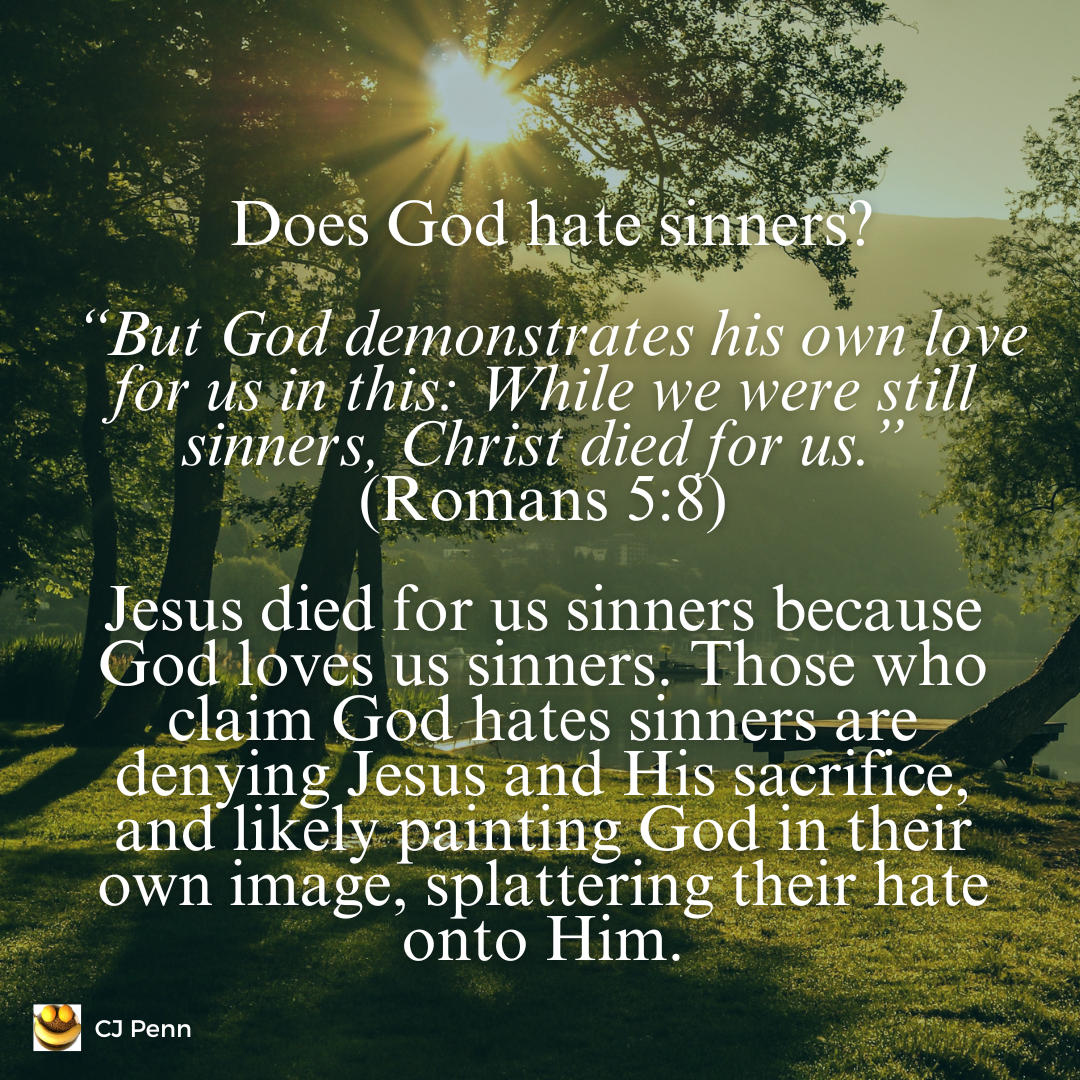
The Bible does talk about God hating sinners, such as in Proverbs 6:16-19 and Psalm 5:4-6. Some so-called Christians take these verses as license for them to shout out that God hates a particular person or group of people. Yet there are two thoughts regarding this that I’d like to place before you.
First, maybe it’s possible for God to both love and hate the same person. Maybe God can love the good, and at the same time hate the evil and sin within a person. I’ve felt that odd combination of emotions, and if I can, God certainly can do even better.
Second, it’s not up to me or anyone else to declare who God hates. That privilege is reserved for Him, and Him alone. For me to declare a particular person or group of people as an object of God’s hate is an act of judgment. And maybe that’s one reason so many outsiders view Christians as judgmental.
It’s not my place to convince anyone of the truth of Christianity. Christians are called to be neither an arguing attorney nor judge. All I’m called to do is be a witness, nothing more, nothing less. As Jesus said:
“You will receive power when the Holy Spirit has come upon you; and you will be my witnesses in Jerusalem, in all Judea and Samaria, and to the ends of the earth.” (Acts 1:8)
“When the Advocate comes, whom I will send to you from the Father, the Spirit of truth who comes from the Father, he will testify on my behalf. You also are to testify because you have been with me from the beginning.” (John 15:26-27)
And while being a witness, I’ll rely on the Holy Spirit to do the convincing. As Jesus also said, “I have much more to say to you, more than you can now bear. But when he, the Spirit of truth, comes, he will guide you into all truth” (John 16:12-13).
Finally, notice the role of the Holy Spirit. D.L. Moody once said, “There is no better evangelist in the world than the Holy Spirit.”
When we look on the surface of modern Christianity, we don’t always see what Jesus had in mind. Rather, we often see a manmade version, a form that at least partially paints Christianity in man’s image rather than God’s image, thus defacing Jesus’ truth.
Of course, many adherents to a manmade version of Christianity are reluctant to accept this claim. As I’ve experienced, some will vehemently argue that the nuances of their religion represent true Christianity, unpolluted by human influence. Over the centuries, their predecessors perfected the arguments approving the authority of their manmade version of church, and their definition of what it means to be Christian.
But consider this, from Jesus: “In fact, the reason I was born and came into the world is to testify to the truth. Everyone on the side of truth listens to me” (John 18:37). Now consider what Peter said when challenged by the religious leaders of his day who clung to their manmade rules and traditions: “Which is right in God’s eyes: to listen to you, or to him? You be the judges!” (Acts 4:19).
The choice facing all who call themselves Christian is, will they listen to Jesus and His truth, or to those who cling to a defaced version of Jesus’ Christianity.
In the Garden of Eden, when Adam and Eve fell for the temptation of Satan, the outcome was as if Satan had infected them with his sinfulness, pridefulness, and selfishness. This virus was then passed onto Adam and Eve’s descendants.
Then, Jesus Christ died to the sin, pride, and self that had infected humanity. And by His death and our faith, we can participate in Jesus’ death and also be dead to the virus of sinfulness, pridefulness, and selfishness.
The best part about all this is that, with death to our sinful nature, we make room for the Spirit of Jesus to take its place so that we can say with Paul, “I no longer live, but Christ lives in me.”
It begins or ends with sleep. I mean, my daily connection with God. Sleep has become a weird experience for me. There’s no control of my thoughts, almost never a thought of God. Though my body’s asleep, my mind seems to never stop. One strange dream after another. It feels like a waste of time. Since my mind’s going to stay active anyway, why couldn’t it instead be with God and Jesus in heaven, resting in their presence, getting ready for the next day?
But this morning it occurred to me that, where it feels like my soul empties itself of God’s presence during my dream-filled sleep, each morning with my coffee cup warming my hands and my eyes closed, I feel myself open up to God, like opening a valve. And then, with my heart and soul again fully open, God pours His Spirit into me.
So, my preparation for each day isn’t found in the rest of a sleepful night. But rather in the quieting and opening of my soul each morning, where I empty myself of self to make room for God. And the best days are when I open and empty myself enough to truly let God be all within me, so I can then say with Paul, “It is no longer I who live, but it is Christ who lives in me” (Galatians 2:20).
I no longer look upon sleep as a waste of time, which I know is a strange thing to say. For me, sleep now presents the opportunity to show my love and commitment to God each morning.
When Jesus said, “Whoever wants to be my disciple must deny themselves and take up their cross daily and follow me” (Luke 9:23), He was talking about denying the worldly and self-centered side of what makes up our personality.
And when Paul said, “I have been crucified with Christ; and it is no longer I who live, but Christ lives in me” (Galatians 2:20), he was referring to the same worldly self. He was talking about his little devil effectively being crucified when Jesus was crucified, making room for the Spirit of Christ to come in and take its place.
Yes, picture the Spirit of Jesus on your shoulder, in place of your sinful self. That’s what Jesus promised when He said, “My Father will love them, and we will come to them and make our home with them” (John 14:23). It can happen.
Entering the campus of Trinity College in Dublin, Ireland, as I followed the herd of other tourists through Library Square, I looked up to see a large sign with this quote from Jonathan Swift.
With respect to the state of Christianity these days, this quote has helped fuel my desire to give truth a shoulder to lean on, especially when so many people are kicking it in the shins.
As you knock on the door of the humble yet attractive house, you feel a bit nervous about meeting the owner. But you couldn’t pass up the bargain rent he was charging for his spare bedroom.
“Well, hello. Please come in,” Jesus says as he opens the door, with a soft smile and a sparkle in his eyes. “Let me give you a quick tour.”
Jesus leads you through the rooms of his warm and cozy home, finishing with the family room.
“This is my computer,” he says, opening the laptop sitting on the well-used wooden desk. The screen lights up to an email app. “You can used this too, whenever you like.”
“Um, thanks,” you reply, a bit confused. “But I have a computer. All I’ll need is a connection to your wifi.”
“Yes, I know,” Jesus says, with a smile and a squint that acknowledges the confusion on your face. “Still, you’re welcome to use my computer, though the only app is email, and it will send emails to only one address.”
“Oh … well … that’s interesting.” You’re beginning to wonder if moving in with him was a good idea.
“My computer sends emails to my Father,” Jesus continues with enthusiasm. “With this, you can ask God for anything, and He will give it to you.”
“But if I do that, my request will appear to God as if it’s coming from you.”
When I get together with friends, we mostly talk about what’s going on in our lives. The gutsy ones talk about politics.
I’ve been thinking, what if God got as much airtime as certain politicians do? I like to visualize a world where people talk more about God than about personalities in the news. I like to visualize a world where God is widely glorified.
Looking at a dictionary definition, to glorify means “to cause to be or treat as being more splendid, excellent, etc., than would normally be considered.” I like to visualize a world where God is seen as more splendid and excellent than He is currently seen. And I like to visualize the impact that would have on society.
Imagine a life where, rather than complaining about politicians, certain societal groups, or the weather, we instead talked about our love for God. I like to imagine that.
What’s it mean to be a disciple of Jesus? As I waited for my morning coffee to fire up the brain cells, some of those cells got stuck on this question. Then my brain took a little walk and stumbled upon these words from Jesus:
“Whoever wants to be my disciple must deny themselves and take up their cross daily and follow me.” (Luke 9:23 NIV)
Hmm. You know, I’ve been on this journey called life a long time. My goals have changed over the years, but as I’ve gotten older—and hopefully a little wiser—my goals have become less focused on myself and more focused on God and Jesus, and my relationship with them. And I’ve come to see that “self” can be a very troublesome character.
Self is that little devil on my shoulder telling me to do the opposite of what my conscience—on the other shoulder—is encouraging me to do. Looking back, I see that self and its utter selfishness is the root cause of almost all my troubles. Either self has created problems directly, or its selfish reaction to external problems has caused me to internalize those problems.
I think it’s my evolving perspective of self that’s helped open my eyes to see a clearer image of what it means to be a disciple of Jesus. For me, it’s denying self. I want to live as if my self were dead. I want to leave self hanging on its cross, and follow Jesus wherever He wants to lead me. And I want to have the peace that Paul promised when he said,
“The mind governed by the flesh [aka, self] is death, but the mind governed by the Spirit is life and peace.” (Romans 8:6 NIV)
I want the Holy Spirit—whom I see as sitting on my other shoulder with my conscience—to control my thoughts. I want the Spirit of Jesus to live within me, and through me, leading me to wherever He wants me to go. And I believe that’s ultimately what it means to be a disciple of Jesus.
There’s someone in my past where our relationship was rancid, and if I see them in the future—which I hope to do—it may be helpful for both of us if I forgive them for some of their past behavior. But with what kind of forgiveness?
I now believe there are two kinds of forgiveness. There’s worldly forgiveness, the kind we so often see, which is a forgiveness that has to be earned somehow by the offending party. Then there’s God’s forgiveness, which is unearned, always offered, just waiting to be accepted. All we have to do, as those who offend God with our sins, is acknowledge those sins, believe in God’s forgiveness, reach out to Him, and accept His forgiveness.
Now regarding that person from my past, God calls me to forgive as He forgives. That person doesn’t need to ask for my forgiveness, they don’t need to earn my forgiveness in any way. Thanks to God and how He has worked within me, my forgiveness is already given. If that person and I meet again, all they have to do is accept my forgiveness.
So what do you think about this idea of earned verses accepted forgiveness?